
The Weight of Legacy - Chapter 1: Twenty Years
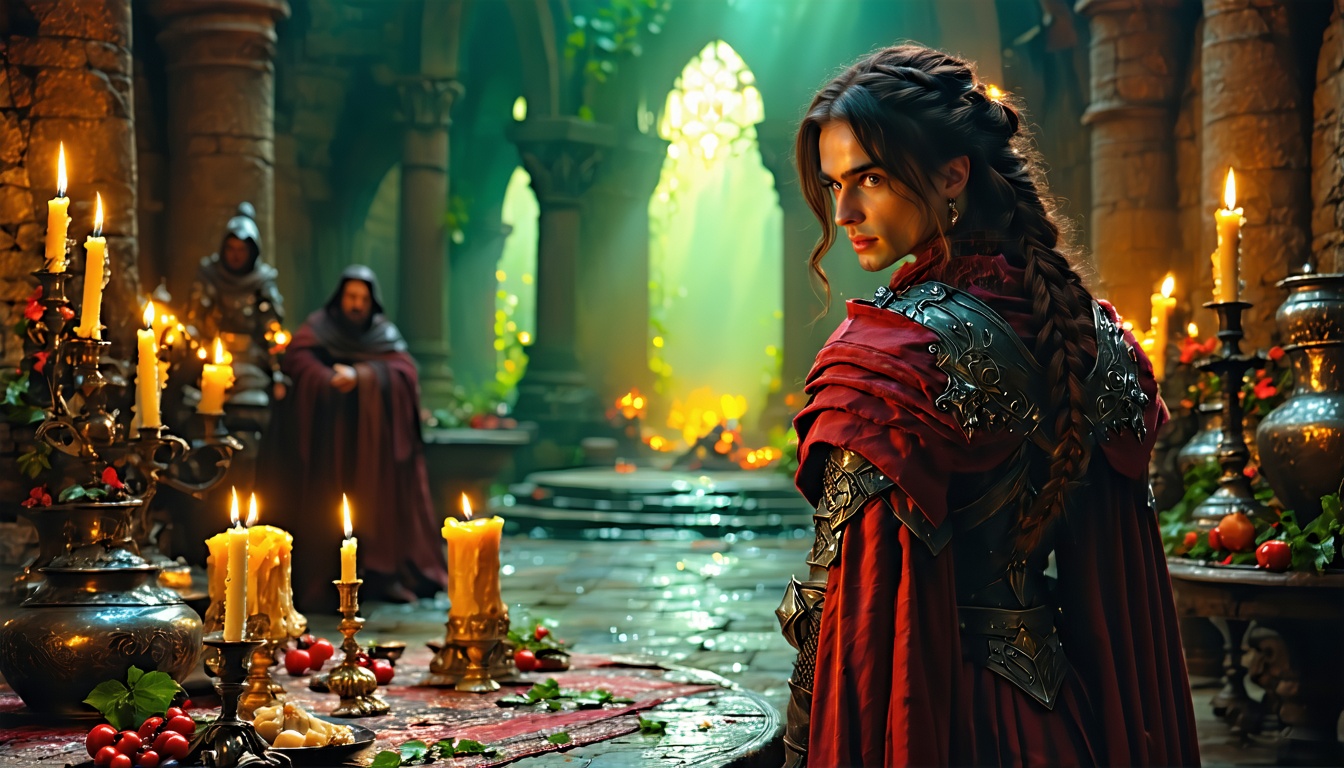
"Why should I inherit the crown just because I was born first?"
Aria's voice cut across the private garden, sharp with challenge.
Elena's fingers tightened around the pruning shears she'd been using to trim the rose bushes--a habit she'd kept from the years when she needed something physical to ground her while she thought. The metal bit into her palm, leaving a white impression on her skin. She set the shears down carefully on the stone ledge beside her, buying herself a breath. The blades clicked against the stone--a small, precise sound in the afternoon quiet.
Her daughter had become a philosopher. Thirteen years old, absolutely certain about everything, understanding almost nothing about what happened when theory collided with the weight of real decisions. She stood in a patch of sunlight with her arms crossed--unconscious imitation of Elena's own defensive posture, which was itself an imitation of Grandmother Aria's. Three generations of the same stubborn stance, the same lifted chin, the same refusal to back down from an argument they believed in.
"Just because I was born first? Because I happened to exit the womb before my siblings? That's not merit. That's random luck dressed up as divine right."
They stood in the garden where Elena had spent transformative hours with her own grandmother two decades ago. The same roses climbing the stone wall, their fragrance thick and sweet in the afternoon air--crimson blooms heavy with late summer, petals already loosening at the edges. The fountain murmured in the corner, water catching the light in brief silver flashes before falling back into the basin. Bees droned among the lavender border, their movements lazy and purposeful, and somewhere beyond the wall a blacksmith's hammer rang against an anvil--the steady pulse of the city going about its business while crowns debated their own necessity. Here Queen Aria--the warrior queen who'd ruled through iron will and an unwavering conviction that strength was justice--had taught her seventeen-year-old granddaughter about the weight of crowns.
Now Elena was on the other side of that conversation. Standing where her grandmother had stood. Hearing the same questions she'd once asked, reflected back at her through a voice that sounded so much like her own that it sometimes stopped her breath.
"It's tradition," she said, and her stomach clenched at how much she sounded like Cassius. Like the conservative voices she'd spent twenty years pushing against. Like every advisor who'd ever told her that the way things were was the way things should remain. "Stability. Continuity. People know what to expect."
"That's exactly what Grandmother Aria's advisors said about harsh justice." Aria's chin lifted another fraction. Sunlight caught the defiance in her green eyes--Elena's eyes, set in Aldric's angular face. "Tradition doesn't make something right, Mama. You taught me that."
The words landed like a blade between ribs. Because Aria was right. The truth of it settled in Elena's chest--that particular ache of recognizing your own arguments used against you, of watching your child surpass the philosophy you'd given her and wield it against the system you'd built.
"Fair point." She picked up the shears again, snipped a dead rose with more force than necessary. The stem split cleanly, the withered bloom tumbling to the flagstones. "But do you know what happened the last time someone tried to change everything at once? People died. Not in the abstract. Real people, bleeding on real streets. I was seventeen. I saw it."
"So you do nothing?"
"So I do things carefully. There's a difference between caution and cowardice." Elena met her daughter's eyes. Green eyes, like her own. Stubborn jaw, like Aldric's. The combination fierce and familiar and frightening. "Though I'm starting to wonder if careful has become my excuse for standing still."
The admission surprised them both. Elena hadn't meant to say it aloud. The words had risen from somewhere deeper than strategy--from the part of her that had been queen for twenty years and was beginning to wonder if the crown had slowly, imperceptibly, become the ceiling she'd once fought to shatter.
"Come on," she said instead of following that thread. "Your father is visiting next week. You can argue political philosophy with him. He's better at defending monarchy than I am."
"Because he believes in it."
"Because he hasn't spent twenty years watching it fail people in small ways every single day." She softened her voice. "And neither have you. Not yet. You see the theory. I see the practice--every petition denied, every justice delayed, every decision I make that affects thousands of lives while they have no say in the matter."
Aria rolled her eyes. But her expression shifted--the first crack in her thirteen-year-old certainty. A flicker of doubt, more complex than conviction.
Good. Certainty was dangerous. Elena's knuckles ached where she'd gripped the shears too tight--the body keeping score of arguments the mind tried to set aside.
She watched her daughter walk back toward the castle, shoulders straight, stride purposeful. So young. So sure the world could be remade by wanting it badly enough. Elena remembered that feeling--the absolute clarity of conviction before experience taught you that every revolution had a cost, and the cost was always paid by people who never asked for change.
The roses needed more trimming. Elena returned to the work--methodical cuts, removing dead wood, shaping growth. The gardener's equivalent of governance: cutting away what had died to make room for what might live.
***
Theo was waiting in the corridor outside the family wing, his ten-year-old face pinched with frustration. He sat on the stone bench beneath the tapestry of the Battle of Thornridge, his legs swinging above the floor, his fists clenched on his knees.
"Master Garrett says I can't sit in on the strategy lessons anymore." His voice cracked with the effort of containing something larger than disappointment. "He says they're only for the heir."
Elena's chest tightened. Her second child, with Aldric's dark curls and her own stubborn chin. Old enough now to notice the differences in how they were treated--the subtle gradations of importance that the hereditary system imposed on siblings who shared the same blood, the same parents, the same claim to being loved.
"Master Garrett is following protocol," she said carefully. The words tasted wrong. Protocol. Another word for the system she was starting to question. Another word for inequality dressed in tradition's clothing.
"But why?" Theo stopped swinging his legs, forcing Elena and Aria--who'd come up behind them from the garden--to turn. His hands balled into fists. "Why does Aria get special tutors and strategy sessions and I get horse riding and poetry? As if I'm too stupid to understand governance?"
"You're not stupid," Aria said, her voice gentler than it had been moments ago arguing philosophy. Whatever their disagreements about crowns and power, she loved her brother--Elena could see it in the way her hand reached out, almost touching his shoulder before pulling back.
"Then why am I excluded?"
Elena knelt. Cold stone through her dress. She brought herself to his eye level the way she'd always done with Marcus when they were young--meeting someone's eyes rather than looking down at them. The posture of equals, not authority.
"You matter," she said. "You matter enormously. Being second-born doesn't change that."
"It changes everything else." His lower lip trembled, but he fought to control it. Ten years old and already learning to hide his pain behind composure. The curse of royal children--trained to suppress before they'd learned to feel.
"You get freedom," Aria said quietly, almost enviously. She sat on the bench beside him, her shoulder touching his. "Do you know what I would give to have your life? To wake up knowing I could choose my own path? I'm trapped. Born into a role I never chose."
Theo stared at his sister. The anger drained from his face, replaced by something more complicated. "You don't want to be queen?"
"I don't know what I want. That's the point. You get to figure that out. I don't."
Elena watched the tension shift between her children--the resentment softening in Theo's eyes, the defensive posture relaxing in Aria's shoulders. Two children in a system that harmed them both differently--one burdened with unearned power, the other diminished by unearned exclusion.
She rose, knees protesting. "The current system isn't fair," she said. "I know that. And maybe it's time to change it." She pulled both children close, one arm around each. Warm bodies, small shoulders, the smell of garden soil and childhood. "But for now--you are not less valuable because you won't inherit the crown. You are not less loved."
"Promise?" Theo asked. His voice small. His hand gripping her sleeve.
"I promise I'll try to fix this. That's all any of us can do. That's all anyone should promise--not perfection, but effort. Not answers, but honest questions."
It wasn't enough. She knew it. But Theo nodded, accepting the honesty if not the answer.
She sent them off together--Aria's arm draped over Theo's shoulders, their heads bent in quiet conversation. Two children carrying burdens they shouldn't have to bear, in a system that assigned their worth at birth.
Three children. Three different burdens. One broken system that treated them unequally from birth.
Her hands were shaking. The tremor had started somewhere during the conversation--her body processing what her mind refused to name. Not just concern. Not just maternal guilt. Something deeper: the growing, terrible suspicion that the system she'd maintained for twenty years wasn't just imperfect. It was wrong. Fundamentally, structurally wrong. And she'd been too comfortable inside it to see.
***
Marcus found her in the war room an hour later. The room smelled of old parchment and the faint bitterness of cold candle wax--the residue of too many late-night sessions over maps that promised clarity and delivered none. Faded red markings still dotted the oldest maps--dead zones from the old wars, areas where the Crown had forbidden settlement until the scorched soil healed. The evening light came through the high windows at a low angle, turning the dust motes to gold and making the room feel like a place suspended between past and present.
Her brother was thirty-four now--the scar on his shoulder from taking a poisoned blade meant for Elena seven years ago visible beneath his collar. That assassination attempt had bonded them beyond what growing up together had already forged. He'd nearly died in her service. The poison had taken three weeks to purge, during which he'd sweated and shivered and cursed while Elena sat beside his bed, helpless, furious, guilty. After recovery, he'd refused her offer of a safer posting. "Where else would I go?" he'd said. "You're my sister. This is where I belong."
"You look troubled," he said now, settling into the chair across from her. "More than your usual baseline of troubled."
"Aria was questioning hereditary succession again."
"She does that weekly."
"This time she meant it. And Marcus--" Elena pressed her palms flat against the strategy table, steadying herself. The wood was cool and smooth beneath her fingers, worn by generations of hands that had plotted wars and treaties across its surface. "I think she might be right."
Marcus didn't react with surprise. Instead, he studied her--the careful assessment of a military commander evaluating terrain. "Would that be the worst thing? If she chose a different path?"
"What scares me isn't her choosing differently. It's that I've spent twenty years building something and my own daughter thinks it's not enough." Her voice cracked on the last word. Not the measured tone of a queen deliberating policy. Just Elena, honest about being afraid. "Twenty years, Marcus. And a thirteen-year-old can see through it."
"Maybe that's what success looks like. Your children seeing further than you did."
"Or maybe I built something so fragile that one idealistic teenager can see through it."
"Elena. The kingdom is stable. Prosperous. People trust the justice system. The trade routes are secure. The borders are quiet. That's success."
"Is it? Or have I just been lucky? Twenty years without a major crisis--maybe that's not my governance. Maybe that's circumstance."
"Seven years without crisis isn't luck. Twenty years isn't luck. It's leadership."
The words offered comfort. But comfort had never been enough for Elena. She needed truth, even when truth tasted like ash.
"What's on the schedule?"
"Routine council. And a woman named Celeste Harwick has asked for formal audience."
A chill ran down her spine. Sir Harwick--the man who'd died exposing Adrian's conspiracy. The knight who'd given his life to uncover the corruption that had nearly destroyed Valdoria from within. "His daughter?"
"She's been researching his reform legacy. University-educated. Graduated top of her class at Crownhaven Academy. Published two papers on governance reform. Wants to present something."
"Schedule her. After council." Elena's instincts were firing--that particular buzz along her nerves that she'd learned to trust over twenty years of governance. Not quite alarm. Not quite excitement. The feeling of something approaching that would change everything, the way a storm changes the pressure in a room before the first thunder sounds.
***
The council meeting was routine. Elena participated actively--approved trade proposals from the Southern Alliance, challenged three judicial appointments on the grounds that the nominees had no experience outside noble circles, flagged an inflated harbor budget that bore the fingerprints of Lord Brennan's shipping interests. The mechanical work of governance she'd done ten thousand times.
Countess Vera supported the budget challenge. Lord Brennan objected with practiced outrage--the performance of a man defending his interests while pretending to defend principles. Elena let him speak, then presented the receipts her auditors had compiled. The committee agreed to an independent review. Small victories. The kind that kept a kingdom functioning without anyone noticing.
But her mind kept circling back to Celeste Harwick. The daughter of a dead hero, coming to the palace with proposals. The symmetry unsettled her--another generation picking up the work that the previous generation had died for.
After council adjourned, guards showed Celeste in.
She was young--barely twenty. Dark hair pulled back severely from a face that was all angles and determination. Scholar's attire--practical wool, ink-stained cuffs, the collar of a woman who spent more time in libraries than at court. The smell of ink and old paper clung to her clothes like perfume. Confidence beyond her years, but earned confidence--the kind that came from knowing your material, not from inherited position.
"Your father was a hero," Elena said. Her voice was warm, genuine. The memory of Sir Harwick's sacrifice still vivid after all these years. "He saved Valdoria."
Grief flickered behind Celeste's eyes--quick, controlled, almost invisible. A tightening at the corners of her mouth. Her fingers, which had been resting on the document case, pressed flat against the leather for a heartbeat before relaxing. The gesture of someone steadying themselves against a blow they'd known was coming but couldn't fully prepare for.
"He died doing what he believed was right." The delivery was flat--practiced, Elena realized. Not the natural calm of someone at peace with loss but the studied evenness of a sentence rehearsed so many times it had become armor. Underneath, a wound lived that Celeste clearly didn't want examined. "That's what I'm trying to continue."
"What specifically?"
Celeste produced documents. Professional quality printing--someone had funded this properly. Not a student's scratchings but a serious proposal, bound and indexed, with appendices and precedent citations. As she opened the first page, Elena noticed the margins. Notes in a different hand--older, the ink faded to brown. Sir Harwick's handwriting, she realized with a start. Celeste was building on her dead father's unpublished notes, carrying his incomplete work forward like a mason continuing a wall someone else had started and never finished. The realization made the young woman's composure suddenly legible: not arrogance but devotion. Not performance but grief channeled into purpose so completely that the grief had become invisible to anyone not looking for it.
"Elected regional councils with real legislative authority. Commons representation. Gradual transition to constitutional limited monarchy."
Elena went still, the blood draining from her face. Her pulse hammered in her fingertips--the same physical jolt that had struck at sixteen when the messenger told her Valdris was invading. Different threat. Same body response. The recognition of something that would demand everything from her.
"You're proposing democracy. Not reform--fundamental transformation."
"I'm proposing accountability beyond individual rulers' character." Celeste's tone was calm, reasonable. She'd rehearsed this--Elena could tell--but the rehearsal hadn't stripped away the passion beneath. "You're merciful and wise. Your grandmother was harsh. The next monarch might be worse. The system shouldn't depend on who happens to be born into power."
The argument hit home--not in her mind, where she'd already been wrestling with these questions for years, but in her gut. Her stomach dropped, the way it had when she'd leaned too far over the castle battlements as a child. That sickening lurch of recognizing a truth you've been avoiding.
"Democracy creates instability," she said. The words came out automatically--the counterargument she'd rehearsed so many times it was muscle memory. The wall she'd built between herself and the questions she was afraid to answer.
"Democracy creates investment. People protecting systems they have voice in." Celeste leaned forward. "You've spent twenty years arguing that everyone deserves voice in the justice system. Why does that principle stop at courtrooms?"
Elena's hands stilled on the table. The question was a mirror held up to her own philosophy, reflecting back an inconsistency she'd never allowed herself to examine. Justice for all in the courts. Absolute authority in everything else. The contradiction was glaring once someone named it.
"I need time to consider this."
"Time is a tool of the powerful. 'I need time' becomes 'maybe later' becomes 'never.'"
"I'm not an establishment. I'm a reformer who--"
"Who reformed twenty years ago. What have you reformed recently?"
Elena had no answer. The silence stretched, and her own heartbeat filled it--a dull, insistent rhythm against her ribs, counting the seconds of her inadequacy.
"I'll review your proposals," she said. "Formal response within a month."
Celeste stood, bowed, and left. Professional. Polite. Devastating. But as she walked toward the door, her stride faltered--barely, for less than a second, the kind of misstep only someone watching closely would notice. Her hand brushed the doorframe as she passed through, fingers trailing along the carved wood the way a person touches something solid when the ground beneath them feels uncertain. Then the composure snapped back into place, and she was gone.
Elena and Marcus sat in silence. The council chamber felt different now--the carved oak and ancient stone no longer the setting of tradition but the architecture of a cage she'd never noticed because she held the key.
"Well," Marcus said.
"She's right." Elena barely recognized her own voice. "About all of it."
"About what specifically?"
"I reformed the justice system. Made trials fairer. But I never asked the real question: Why should I have this power at all?" She picked up the proposals. Her hands were trembling--the same tremor that had shaken them at sixteen when she'd said "I will" and ridden toward her first war. "What if being a good ruler means accepting you shouldn't be ruling?"
Marcus had no answer.
Neither did Elena.
But the question burned in her chest like something alive. Not abstract philosophy. Not a theoretical exercise. The same visceral, terrifying certainty she'd felt riding toward Ashfield as a teenager: that something enormous was about to change, that she was afraid, and that she was going to do it anyway.
***
That evening, Aria found her in her study. The lamp had burned low, filling the room with the warm, slightly acrid smell of oil. Outside, crickets had begun their evening chorus--a sound so familiar Elena usually let it wash past her, but tonight every small noise pressed against her awareness. The castle settled around her, ancient stones sighing as they cooled, and each sound carried the weight of centuries of rulers who'd sat in this chair, read by this light, wrestled with decisions that would outlive them.
Elena told her about Celeste's visit. Watched her daughter's face transform as she described the proposals.
"She's right!" Aria's eyes lit up--not with the abstract enthusiasm of philosophy but with the fierce, personal conviction of someone who'd been waiting to hear that the world could be different. "About all of it!"
"Maybe." Elena's fingers curled against her thighs. "But understanding why something should change isn't the same as knowing how to change it without people getting hurt."
"That sounds like an excuse."
"It sounds like experience. I've watched revolutions in other kingdoms. Every one that moved too fast ended in blood. The Thornmark Republic lasted three years before the backlash killed ten thousand people. The Seaford Uprising burned its own leaders. You can believe in an idea and still recognize that implementing it badly is worse than not implementing it at all."
"So you do nothing?"
"So I do things carefully. Reform is surgery, Aria. You don't cut wildly." The words echoed back at her--hollow. Not caution. Fear. The fear of letting go of the only identity she'd ever known.
"You're scared," Aria said. Not accusation. Recognition. The quiet clarity of a child seeing her mother whole for the first time--not as a queen, not as an authority, but as a person afraid of change.
Her throat tightened. Her daughter, seeing her clearly. Seeing past the crown and the composure and the twenty years of practiced certainty.
"Yes," she admitted. "I'm terrified. I've held this power for twenty years. It's who I am. And someone just told me I should give it away."
"And you think she's right."
"I think she might be. And that terrifies me more."
They stood together in the lamplight. Mother and daughter. Queen and heir. Two women on opposite sides of a question that had no safe answer.
"You're better than Grandmother was," Aria said, hugging her. Elena felt her daughter's arms tighten--fierce, protective, the reversal of every embrace they'd ever shared. "You listen. Even when you're scared."
"I try."
After Aria left, Elena stood at the window. Twenty years of rule. Thousands of decisions. And now someone was saying it wasn't enough. That she'd become what she'd fought against--not through malice but through comfort. Through the gradual, imperceptible process of mistaking stability for justice.
Her chest tightened. She leaned against the window frame, the stone cool and unyielding against her shoulder.
She wrote to Aldric that night, sitting at her desk with the lamp burning low. The nib scratched against parchment--a sound that had comforted her since girlhood, the rhythm of thought becoming word.
*Aldric,*
*Something happened today that's shaken me to my bones. Not a conspiracy or an assassination. Worse. A young woman walked into my council chamber and told me everything I've built isn't enough. That I reformed the symptoms while leaving the disease intact.*
*Our daughter agrees with her. Enthusiastically.*
*And I think they might be right. Both of them.*
*I'm scared, Aldric. Not the way I was scared at sixteen riding to Ashfield--that fear had a clear enemy, a sword to swing. This fear is quieter. The fear that twenty years of work might have been building a prettier cage instead of tearing the cage down.*
*I need you. Not your political opinion. I need my husband. The man who holds me when I'm shaking.*
*Come soon.*
*I love you.*
*--Elena*
She sealed the letter with her personal seal--the rose she'd chosen at sixteen, before crowns and compromise had reshaped her understanding of the world. The wax cooled in the night air, hardening into something permanent. Red as blood. Red as conviction.
She sent it by priority courier into the darkness.
Then she returned to the endless work. Budget reviews, judicial appointments, trade negotiations. But the work tasted different now. Uncertain. Every decision felt provisional--a temporary arrangement awaiting a reckoning she could no longer postpone.
Maybe that was good. Certainty had always been dangerous.
Or maybe uncertainty meant she was losing the confidence to lead.
Twenty years. Thousands of decisions.
She still didn't know what she was doing.
She was afraid.
She was going to keep going anyway.
She was Aria's granddaughter. She was Elena.
Whatever that meant now.