
The Weight of Legacy - Chapter 3: Generational Divide
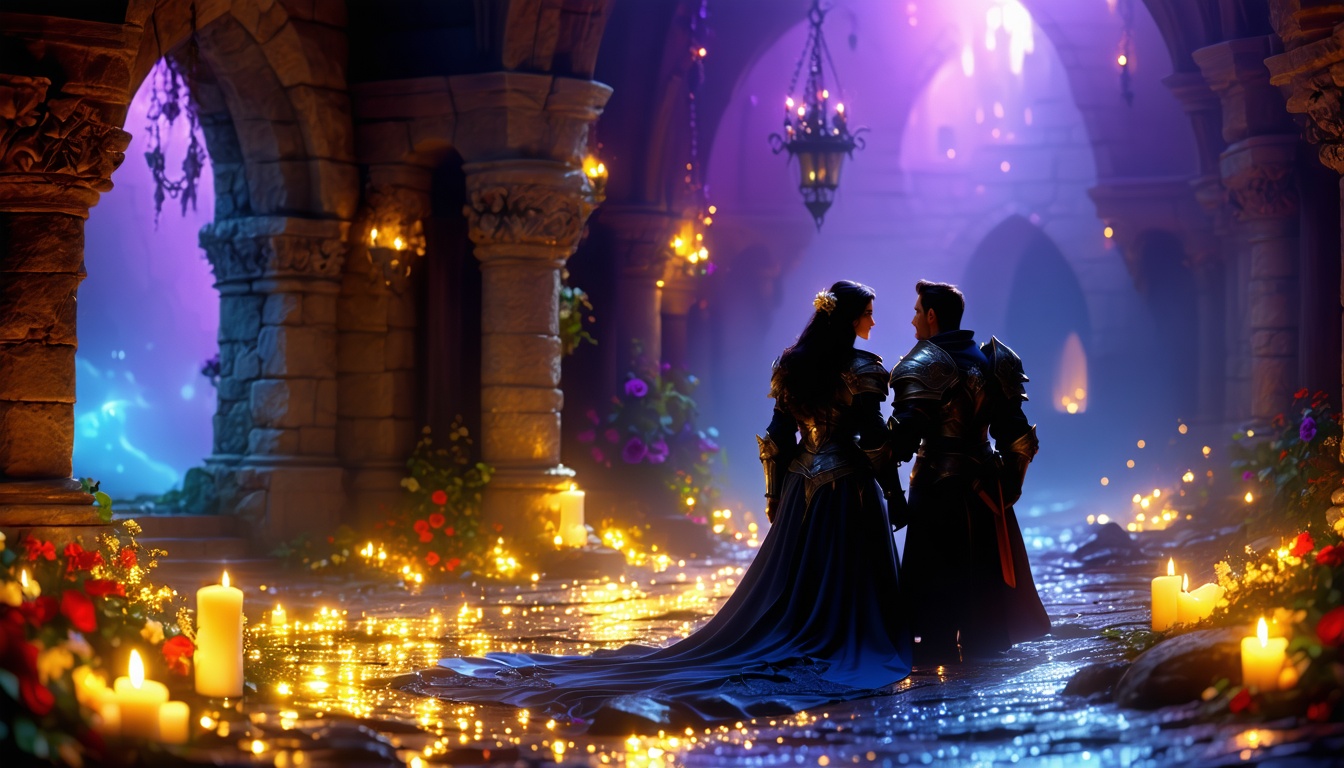
Aldric arrived on a grey morning with storm clouds massing on the horizon.
From the castle's highest balcony, Elena tracked his carriage as it crossed the drawbridge. The wind whipped at her hair, carrying the smell of rain and something else—the copper tang of lightning waiting to strike. Twenty years of marriage. Twenty years of knowing each other—starting from that diplomatic reception when she was seventeen and he was the handsome crown prince of Valdris who'd made her laugh for the first time since becoming queen. Two children together. Alliances both political and personal binding Valdoria and Valdris through marriage.
The carriage wheels struck the cobblestones with rhythmic thuds, each impact echoing off the castle walls. Guards snapped to attention, their armor clinking in the damp morning air. Elena's chest tightened—her breath caught—loss and longing and the copper taste of fear at the back of her throat.
She'd written to him about Celeste's proposals. Explained the philosophical challenge, the arguments that kept her awake at night, the questions she couldn't answer alone. Asked for his perspective with the desperation of a woman who needed someone to tell her she was either right or wrong—either would be better than this endless uncertainty.
His response had been brief: *I'm coming. We'll discuss in person.*
Three words where there should have been pages. Aldric was never terse unless he was angry or concerned. Usually his letters sprawled across pages—observations about Valdris, anecdotes about their children's latest escapades, tender expressions of love despite the distance between them. Three words felt like a door slamming shut.
She was descending to meet him when Marcus intercepted her on the stairs. The torch-lit corridor smelled of old stone and anxiety.
"You should know—Celeste organized public demonstration yesterday." Marcus kept pace beside her, his voice low. "Two hundred people in the market square. Chanting about democracy. Distributing pamphlets printed on good paper, not cheap stuff. Professional organization."
"Two hundred? That fast?"
"She's organized. Has been organizing for months, probably years. Building networks in the shadows. The council presentation wasn't beginning—it was culmination. She built foundation before making demands visible. Classic insurgent strategy."
"Why didn't intelligence know?"
"Because she was careful. Worked through university networks—students discussing philosophy, not politics. Guild associations—merchants talking about representation, not revolution. Nothing explicitly political until now. She played the long game, and she played it well."
"But there's something else." Marcus pulled a folded paper from inside his coat—cheap stock, the kind used for broadsheets in the lower city. "This was pinned to the council chamber door before dawn. Guards removed it but I kept the original."
Elena unfolded the paper. The handwriting was deliberate, each letter formed with careful precision that erased any identifying flourish: *Those who dismantle the throne will be buried beneath its stones. The queen's experiment ends when patient men lose patience.*
Her skin prickled. Not fear—she'd grown past fearing anonymous words. Something colder. The recognition that philosophical opposition was curdling into something with teeth.
"Isolated crank?"
"I don't think so. We've intercepted three similar messages this week—different handwriting, same sentiment. And Lord Brennan's hunting companions have been making remarks at their clubs. Not direct threats. More like prophecies. 'Someone will stop this before it goes too far.' 'The old ways have their own defenders.' The kind of language that gives permission without giving orders."
"Monitor it. Double intelligence in the noble quarters."
"Already done." Marcus hesitated on the stair—unusual for a man who moved through the world with deliberate certainty. "Elena, Celeste isn't just organizing. She's exposing herself. Public demonstrations, printed pamphlets with her name on them. If someone decides to make an example—"
"Then we protect her."
"We can try. But you can't protect an idea's champion without caging the idea."
Elena's jaw clenched. She'd been outmaneuvered by a woman half her age. Celeste had prepared the battlefield before declaring war, and Elena hadn't even known there was a war coming. And now someone—several someones—was responding not with counter-arguments but with threats.
"Handle damage control. Keep it from becoming riots. And find out who's writing those letters."
"And Aldric?"
"Let me worry about my husband."
***
Aldric swept into the private dining room like a thunderstorm. Tall, dark-haired, carrying himself with the confidence of a king who'd never questioned whether he deserved his throne. He wore traveling clothes still—leather boots dusty from the road, cloak damp from the threatening weather. He'd come straight from the carriage without stopping to change, and that haste told her everything about his state of mind.
"Elena." He kissed her cheek. The brief contact carried his familiar scent—leather and sandalwood, the cologne he'd worn since they were newlyweds. For a moment, she wanted to sink into his arms and forget everything. Forget Celeste. Forget democracy. Forget twenty years of slowly growing apart. "You look tired."
"I am tired. This situation exhausts me. I haven't slept properly in days."
"What situation? A girl proposing revolution? Suppress her. You have the authority."
"And become my grandmother? Crushing dissent through force? Grandmother Aria executed seventeen people for speaking against her rule. Should I start building scaffolds?"
"Become effective. Not every response to challenge is tyranny. There's space between massacre and surrender."
They sat at the breakfast table, the polished wood reflecting the grey light from the windows. Elena served herself from the platters—eggs going cold, bread hardening at the edges, sliced fruits that had been fresh hours ago when the servants first set them out. The faint smell of overcooked coffee drifted from a silver pot at the table's center. She wasn't hungry but needed the routine, needed something to do with her hands.
"You read Celeste's proposals?"
"I read them. They're dangerous. Beautifully written, philosophically sophisticated, and extremely dangerous."
"They're thoughtful. Detailed. Addressing real grievances that I've tried to address through reform and failed."
"Grievances can be addressed without destroying monarchy."
"Can they? Democracy has precedent. The Free Cities across the Narrow Sea function without kings. They've governed themselves for two centuries, and they're wealthier per capita than any kingdom on the continent."
"The Free Cities are small, homogeneous, economically focused. Merchants who care about trade agreements, not philosophy. Your kingdom is diverse. Fractious. Held together by crown's unifying authority. Take away the crown and what holds it together?"
"Maybe it could be held together by something better. Maybe shared governance creates stronger bonds than imposed authority."
Aldric set down his knife. The metal scraped against ceramic with a sound that made Elena's teeth ache. "Elena. What's happening? This isn't the woman I married. That woman believed in reform through existing structures, not tearing structures down."
"I'm questioning things I should have questioned years ago. Whether hereditary monarchy is legitimate. Whether my reforms went far enough or just made injustice more palatable. Whether I've become what I once opposed without realizing it."
"You've become a wise ruler. That's not the same as tyrant."
"My grandmother probably thought the same thing. She thought she was being wise when she executed those seventeen people. Thought she was protecting the kingdom from dangerous ideas. How am I different?"
"Because you haven't executed anyone for speaking! The comparison is unfair."
"Is it? I still hold absolute power. I still make decisions for people who have no voice in them. The only difference is I use that power more gently. But it's still the same fundamental injustice—one person deciding for millions. What gives me that right?"
Aldric was quiet for a moment. Outside, the first drops of rain began to strike the windows, soft at first, then harder. Then: "Our daughter called me three times last week. Long conversations about democracy. Justice. Hereditary privilege. She's been radicalized."
"She's been thinking. Those aren't the same."
"They are when a thirteen-year-old questions the foundations of everything her parents built. Everything her grandparents and great-grandparents built. Twelve generations of rule, and our daughter wants to end it."
"Maybe foundations need questioning. Maybe that's healthy. Maybe every generation should challenge assumptions instead of blindly accepting them."
"And maybe some foundations exist for good reasons. Stability. Order. Continuity. You can't build anything lasting on ground that shifts with every generation's whims."
"Foundations of sand look stable until the wave hits."
"That's Celeste's rhetoric."
"That's philosophy I've been considering for twenty years—since the first time I looked at my grandmother's portrait and wondered if I'd become her. Celeste just articulated it clearly. Gave me words for thoughts I'd been afraid to speak." Elena traced the grain of the tabletop with one fingernail, following a long scratch she had never noticed before. The small focus anchored her.
They ate in tense silence. The food turned to ash in Elena's mouth. Outside, rain began in earnest—first drops spattering the windows, then steady drumming that filled the quiet room with white noise.
"What do you want from me?" Aldric asked finally. His voice had softened, the anger giving way to something rawer—his fingers curled around the edge of the table, knuckles white. "You asked for my perspective. Here it is: Democracy is unstable. History proves it. Power-sharing creates gridlock. Revolution—even gradual evolution—destroys what you've built. Don't do this."
"And if I think it's right? If I think my grandmother's approach—absolute authority, wise or not—was fundamentally unjust no matter how gently applied?"
"Then you'll destroy everything you've sacrificed for. Everything we've sacrificed for."
"Or complete it."
Aldric reached across the table. Took her hand. The warmth of his palm against hers sent a jolt through her—they'd been so distant lately, she'd forgotten what his touch carried. Separate kingdoms. Separate responsibilities. Together for children, for alliance, but the intimacy had faded into something that resembled diplomatic protocol more than marriage.
"Elena. I love you. Have since we met, since that ridiculous diplomatic reception where you lectured my father's minister about trade tariffs and I fell in love with your passion before I even learned your name. But this... this scares me. You're proposing to upend everything we know."
"I'm proposing to make it better."
"That's what Adrian said."
The name hit like a slap. Adrian Terrence—the revolutionary who'd nearly destroyed everything seven years ago. The man who'd argued for democracy through violence. The man whose conspiracy had killed thirty-seven people, including two of Elena's cousins.
"That's not fair." Elena's hand tensed in his grip.
"Maybe not. But it's relevant. He also thought he was improving things. Making monarchy accountable. Giving power to people. Where did that lead? To blood on palace floors. To Elena crying over her cousins' bodies."
"It led to me crushing his conspiracy and implementing reforms that prevented its repetition."
"And now you want to implement his goals through legitimate means. How is that not validating his approach? How is that not telling every future revolutionary that violence works—it just takes longer?"
"Because method matters. Violence is wrong. Peaceful reform is right. The goals can be correct even if Adrian's methods were monstrous. You can want justice and still condemn injustice in pursuit of it."
"Or the goals are inherently destabilizing and anyone pursuing them—violently or peacefully—ends at the same catastrophic result."
Elena pulled her hand back. "You're afraid."
"I'm experienced. I've seen what happens when rulers weaken themselves. Seen kingdoms collapse under democratic experiments. Seen mob rule replace enlightened authority. Seen the aftermath—famine, civil war, decades of chaos that killed more people than any tyrant could have."
"You've seen one version of democracy fail. That doesn't mean all democracy fails."
"You're willing to gamble your kingdom on that distinction?"
"I'm willing to consider it. Is that so terrifying?"
They finished breakfast in silence. The rain intensified outside—a proper storm now, thunder rolling across the sky like the gods themselves were arguing.
***
Young Aria found them in the library an hour later. Her entrance transformed the atmosphere from cold standoff to something warmer but no less complicated.
The library smelled of old paper and leather, centuries of accumulated knowledge lining the walls in bound volumes. Rain tapped steadily against the windows, a counterpoint to the silence between them. Afternoon light filtered through the rain-streaked glass, casting everything in shades of grey.
"Papa!" She hugged Aldric with genuine affection, throwing her arms around him with the enthusiasm of a child who'd missed her father. Whatever philosophical differences existed, she loved him.
"My brilliant radical." Aldric held her close, breathing in the scent of her hair, then stepped back to examine her face. His expression softened in a way it never did for anyone else. "You've grown. Again. Stop that."
"I'll try to stop aging. I'll tell my body to stay thirteen forever." Aria's smile faded as she looked between her parents, reading the tension in their postures with the bluntness of someone too young for diplomatic pretense. "You fought about Celeste's proposals, didn't you?"
"We disagree," Elena said simply.
"About whether democracy is better than monarchy?"
"About whether changing our system is wise," Aldric corrected. "I don't oppose democracy in principle. I oppose destabilizing a functioning kingdom for theoretical improvement that might never materialize."
"But it isn't functioning for everyone, is it?" Aria's voice climbed. "Commons have no voice. None. A farmer in the eastern valleys lives and dies by policies made by nobles who've never held a plow—and you call that functioning?"
"Commons have justice. Have protection. Have stability. That's function."
"That's benevolent dictatorship."
Aldric's face hardened. "Is that what you think of my rule? And your mother's? Dictatorship?"
"I think you're both trying to be good. Genuinely." She cut off whatever Aldric was about to say with a raised hand—a gesture so like Elena that it made her mother flinch. "But good intentions don't make a system just. A kind master is still a master, Papa. You can't dress up control as caring and expect people not to notice."
"And democracy is what—utopia? People tearing at each other for power? Competing factions creating gridlock? Demagogues whipping crowds into fury?"
"People governing themselves. Yes, they'll make mistakes—of course they will." She threw up her hands. "But at least the mistakes will be theirs. Right now we make the mistakes and everyone else just has to live with them."
"Until their mistakes affect everyone else. Until one region's bad choices impact the entire kingdom. Until a democratic majority decides to persecute a minority because the mob demands blood."
The argument continued—father and daughter debating with a heat that made Elena both proud and anxious. Aria held her own. Challenged assumptions. Made points even Aldric had to acknowledge were valid.
But Aldric made points too. Real concerns about implementation. Questions about transition that nobody had good answers for. Worries about exploitation by bad actors who would use democracy as cover for their own power grabs.
"What about foreign powers?" Aldric pressed. "The Free Cities have been waiting decades for your mother to weaken. Democracy gives them opening. Divided kingdom is vulnerable kingdom."
"Then we build alliance with them instead." Aria's eyes flashed—that quick fierce certainty that bypassed caution entirely. "If they're democratic, we share values. It's not complicated, Papa."
"Partnership with nations that have funded insurgencies against your mother for years? Partnership with people who've tried to destabilize everything she's built?"
"Or maybe—just maybe—the insurgencies stop when the grievances are addressed." Aria pushed back from the table, frustration vibrating in every line of her body. "Maybe they were never opposed to us. Just opposed to this." She gestured at the library, at the castle walls, at everything they represented.
"Or maybe they see democracy as opportunity for infiltration and manipulation. Easier to corrupt many representatives than one monarch."
Elena listened, her jaw clenched, teeth pressing together until the ache spread to her temples. Her daughter's arguments pressed against her from one direction, her husband's fears from the other—a vise tightening around something she couldn't name. Where had Aria read about the Free Cities alliance? Who had taught her that counterargument? And Aldric's fears ran deeper than she'd understood, rooted in histories he'd never shared.
The afternoon darkened as the storm continued. Eventually Aldric had to leave for another engagement—meetings with his own ambassadors that couldn't be postponed. He kissed Elena's cheek again. The contact lingered longer this time.
"Be careful," he murmured against her ear. "Whatever you decide. Be careful."
"You sound like you think I've already decided."
"Haven't you?"
She didn't answer. He sighed—a sound that carried twenty years of marriage, of knowing each other too well—and left.
***
That evening, Elena convened the study committee she'd promised. But instead of delegating, she participated directly, sitting at the table as an equal rather than presiding from above. The committee room was smaller than the council chamber—close enough that she could smell the lavender one lord used to scent his clothes, the stale wine on another's breath.
Twelve members. Four traditionalists who would oppose anything that limited monarchical power—their faces set in expressions of anticipatory disapproval. Four progressives sympathetic to reform—eyes bright with barely contained enthusiasm. Four neutrals whose positions might shift based on evidence—the ones who actually mattered.
They reviewed Celeste's proposals paragraph by paragraph. Debated implementation details that might determine success or failure. Examined precedents from other kingdoms that had experimented with shared governance.
The work was exhausting. Contentious. Necessary.
"Regional councils are feasible," Countess Vera admitted after hours of discussion. Her voice was hoarse from arguing. "Eastern Province already has informal merchant councils that function effectively. Formalizing them with legal authority isn't revolutionary—it's recognizing existing reality."
"Existing reality that operates under crown authority," Lord Brennan countered. His face had gone red with frustration. "Giving them independence changes power dynamics entirely."
"Power dynamics that currently exclude ninety percent of the population from any voice in governance. Ninety percent who are expected to pay taxes, fight in wars, and obey laws they had no part in making."
"Ninety percent of the population lacks education to make informed decisions about governance."
"Then we improve education. That's not argument against democracy—it's argument for better preparation. We don't deny people the vote because they can't read—we teach them to read."
The debates continued late into the night. Candles burned down to stubs and were replaced, hot wax dripping onto the table where Elena's hand rested—she barely flinched. Tea grew cold in cups. Arguments circled and returned, deepened and resolved, broke apart and reformed.
Elena listened more than spoke. Her back ached from hours in the straight-backed chair, and she shifted her weight, the wood creaking beneath her. She pressed her thumbnail into the pad of her forefinger—a habit from childhood, the small pain sharpening her focus when her mind threatened to drift.
Some concerns landed like stones in her chest. Transition risks—how to shift from absolute monarchy to constitutional system without creating a power vacuum that enemies could exploit. External threats—what happened if war came while councils debated? She felt the weight of those questions in her shoulders, the tension crawling up the back of her neck.
Faction formation. Economic impacts. Merchants needed predictability to plan. These weren't excuses to maintain power. They were real problems requiring real solutions, and each one settled into her body like another stone added to a cairn she was building against the tide.
But other objections made her jaw clench. Lord Brennan's fist on the table hard enough to rattle the tea cups: *This is how we've always done it.* Lord Hasting, whose servants dressed him each morning, leaning back in his inherited chair: *Commons don't understand.* The crack in another lord's voice betraying the fear underneath the certainty: *You'll destroy everything.*
Elena could feel the distinction in her body before she could name it in words—the genuine concerns tightened her stomach with honest worry, while the reflexive resistance made her shoulders brace as if against a wind that carried nothing but noise.
The distinction was clear enough. That was something.
***
After the committee adjourned, she walked the castle gardens despite the late hour. Rain had stopped. Stars emerged between parting clouds. The air smelled of wet stone and growing things, of the particular freshness that comes after storms.
Marcus found her by the fountain. The water whispered against marble in the darkness. Neither spoke.
"What do you think?" she asked eventually.
"I think you've already decided."
"Everyone keeps saying that."
"Because it's obvious. You're not studying whether to reform—you're studying how. You wouldn't convene that committee if you hadn't already made your choice."
"And if you're wrong? If I'm genuinely uncertain?"
"Then you're the best actor I've ever seen. Elena, you've been questioning hereditary monarchy for twenty years. Since I first met you, since you were seventeen and already wondering if you deserved the power thrust upon you. Someone finally gave you permission to act on those questions."
Elena dipped her hand in the fountain. The water was cold. Real. Grounding.
"I'm afraid."
"Good. You should be. This is terrifying."
"Not helpful."
"Honest, though. Elena, if you do this—if you implement democratic reforms—you'll face opposition like nothing before. Traditionalists will resist with everything they have. Foreign powers will exploit any weakness. Radicals will demand more than you can deliver. You'll be attacked from all sides, hated by everyone, satisfying no one."
"The threats—are they credible?"
Marcus was quiet for a moment, the fountain whispering between them. "Three anonymous letters in a week. Hostile language spreading through the noble quarters like a fever. I've tripled guard rotation and put watchers on Celeste's residence." He paused. "Someone left a skinned rabbit on her doorstep yesterday. No note. Didn't need one."
Elena's stomach turned, but her voice held steady. "And you didn't mention this earlier because—"
"Because you were carrying enough. And because I'm handling it. But you should know: the resistance isn't just philosophical anymore. It's personal. And it's escalating."
"So I should maintain status quo? Do nothing? Let my grandmother's legacy stand unchallenged?"
"I didn't say that. Just... go in with open eyes. Know what you're risking. Not just your crown—your marriage, your family, your life. These people aren't writing letters because they want to be heard. They're writing them because they're deciding what to do when words aren't enough."
"I've been risking things for twenty years. This is just another risk."
"This is the biggest risk. You're proposing to give away power voluntarily. No monarch has ever done that successfully. They've been forced to, conquered into it, but never chosen it."
"Then I'll be the first."
"Or you'll prove it's impossible."
"Wouldn't be the first impossible thing I've tried."
Marcus laughed despite himself, the sound strange in the quiet garden.
"Every choice carries contradictions. Every path has costs."
She pulled her hand from the fountain. Dried it on her dress.
"I'm going to do it," she said. "Not immediately. Not recklessly. But I'm going to transform this monarchy into something better. Something that doesn't depend on who happens to be born into power."
"You're sure?"
"No. I'm never sure. But I'm committed. That'll have to be enough."
They walked back to the castle. Dawn approached, the sky lightening from black to grey to pale gold. Another impossible day ahead.
But something had clarified.
Elena wasn't the reformer she'd been twenty years ago. She'd grown comfortable. Defensive. The crown had settled so firmly on her head that she'd stopped feeling its weight. The young woman who'd questioned everything had become a queen who protected the status quo while telling herself it was enough.
Time to remember what reform felt like.
Time to become uncomfortable again.
Whatever that cost.