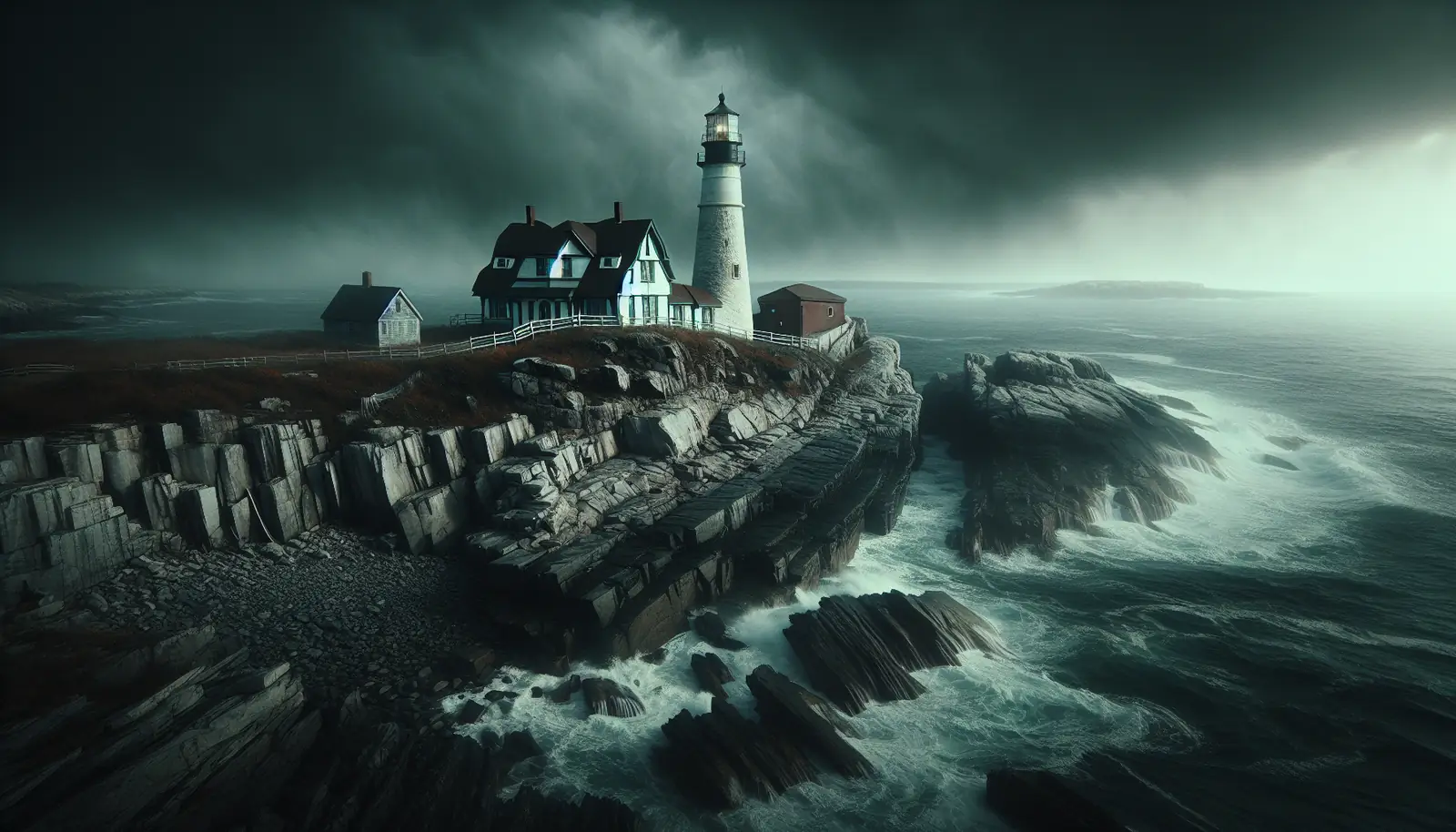
Deleted Scene: The Cottage, October 1994
There is a prologue I cut from Hemlock about six months before publication.
I cut it for one structural reason and three smaller ones. The structural reason is that Hemlock opens, in the published book, on Maya in the present tense in a Pacific Northwest operations center, briefing the team on the Board's ninety-day deadline. That is exactly where book three needs to start. A 1994 prologue, however good, would have made the book feel like a reference document for the first eight pages, and Hemlock is the book where the reader most needs to be inside Maya's head from word one. So it went.
But I have kept the scene in my drafting folder for two years now, and I keep coming back to it, and the Behind the Scenes tag is the right place for it to finally come out. This is a non-canon prologue in the sense that it does not appear in the published novel. It is canon in every other sense — every detail in it is established or implied by the books that follow, and Lily Morgenstern's interior, in particular, is exactly what it is in Hemlock and Foxglove.
If you have not finished Wolfsbane, this scene contains one quiet spoiler about Lily, and one larger one about who Eleanor turned out to be. Save it for after.
— Elara
The Cottage
October 1994. A stone cottage on the western coast of Scotland, three hours by train and an hour by hire car from Glasgow. The roof leaks in two places. The kettle, which has been on the cottage's iron stove since before the most recent owner moved out, is whistling.
There were five of them in the kitchen.
Lily Morgenstern, thirty-five, stood at the window with her hands wrapped around a mug she had not yet drunk from. She had come from London on the morning train and had not slept on the train, and she was wearing the woollen jumper Sarah had knitted for her last Christmas, and she had not taken the jumper off in eleven months because Sarah had been dead for ten and a half of them. Her hair was tied back in a way that did not flatter her face. She did not care. She had not, in eleven months, cared.
Miranda Walsh, forty-two, sat at the head of the table. She was the only one of them in clothes that had been ironed. Twenty years in a particular sort of British civil service, she had once explained, taught a person to iron her clothes when she was about to do something she could not undo, because the ironing was a way of telling oneself that the one was still going to require shoulders and a collar. She was the one who had bought the cottage, two months earlier, in cash, through a solicitor who had not asked questions because he was being paid to not ask questions. Miranda was the only one of them who knew the cottage was paid for in cash from an account that did not, technically, belong to her.
Beatrix, sixty-one, sat on Miranda's right with a cigarette she had not lit. Beatrix had been a nurse in two wars. She had also been, in the third war, the one nobody officially fought, the woman the field hospital sent in when the field hospital had decided a particular casualty needed help going. Lily had never asked Beatrix how many people Beatrix had helped that way. Beatrix had never told her. Beatrix had a reputation for using her hands the way other women used a kettle.
Eleanor sat across from Beatrix. She was thirty-eight, blonde, soft-spoken, and a divinity-school dropout in her own telling. None of that was true. Not the age, not the school, not the dropout. Lily would not learn this until 2018, in a Vienna safe house, while reading a stack of files that Miranda had stolen out of a Board archive and then died trying to keep. Eleanor, in October 1994, was a fully credentialed officer of a major Western intelligence service, on assignment to seed and then steer the precise project that the women in the kitchen believed they were starting.
The fifth woman was Frances. Lily had known Frances since university. Frances was the one who had brought Lily here. Frances had a daughter who was thirteen and she had been told, the previous week, that the man who had hurt her daughter would not be charged because of what could and could not be proved. Frances was very calm. She was the kind of calm a person becomes after a sufficient amount of paperwork.
The kettle whistled. Lily turned from the window and lifted it off the stove. She poured water into a teapot that Miranda had set out, with a kind of formality Miranda had been performing all morning, as if the teapot were a small ceremony of its own.
"Right," said Miranda. "We start where we agreed to start."
"We start with the rule," said Beatrix.
"The rule," Miranda agreed, and looked at each of them in turn. "We will not kill people whose guilt we cannot establish to our own satisfaction. We will not kill people the law could reach, if the law would only try. We will not kill people who would make us into vigilantes when patience would make us into citizens. Are we agreed."
"Agreed," said Beatrix.
"Agreed," said Frances.
"Agreed," said Eleanor, and her face did exactly what it had been trained to do.
Lily put the teapot down. She was the last to answer because she was the one who had, in a back room of an inquest in March, watched a barrister look at her over the top of his glasses and say I am sorry, Dr. Morgenstern, but the evidence is what the evidence is. The evidence was that her thirteen-year-old daughter had been alone with a man, and then the daughter had been dead, and there was no other evidence. There were three other girls who had not died. There was a record of complaints. There was a pattern. There was, the barrister said, no case.
Lily had spent the seven months since the inquest learning, very slowly, that a person who could not get the law to act on her behalf had two choices. She could stop, or she could find a quieter law. She had found Frances. Frances had found Miranda. Miranda had brought them all here.
"Agreed," Lily said.
"All right," said Miranda. "Then this is the second rule. We do not work alone. There must always be at least two of us, on every undertaking, so that the second of us can stop the first. So that no one of us, on any single morning, decides what justice requires. Are we agreed."
"Agreed," said Beatrix.
"Agreed," said Frances.
"Agreed," said Eleanor.
"Agreed," said Lily.
"Third rule," said Miranda. The cigarette in Beatrix's hand was still unlit, and she was now, very slowly, starting to spin it between two fingers. "We use what cannot be traced. We do not use bullets unless there is no other way. We do not use anything that points back at us by virtue of itself. Beatrix has agreed to teach the rest of us what the rest of us need to know."
Beatrix nodded. The cigarette stopped spinning. Beatrix said, "And we do not use anything I would not put in my own mouth, in extremis. If I would not put it in my own mouth, we are not ready to put it in someone else's."
"Agreed," said Lily, and meant it.
"Fourth rule," said Miranda. Eleanor, across the table, had not yet drunk from her mug. Eleanor would not drink from her mug for the next three minutes, because Eleanor had been told, at her last briefing, that the founding meeting of the project would have a very particular structure and she should not interrupt it. Eleanor's job, at this meeting, was to listen. She was listening with her whole face.
"Fourth rule," Miranda said again. "If we are wrong, we stop. If we discover we have killed someone we should not have, we stop and we say so to each other. We do not protect each other from the news of having been wrong. We do not hide it from ourselves. We do not let the project become a thing we are protecting from its own mistakes. Are we agreed."
There was a very long pause.
"Agreed," said Beatrix.
"Agreed," said Frances. "Yes. Agreed."
"Agreed," said Eleanor, and she looked, in the saying of it, as if she might have meant it. Lily would think about this much later. Lily would think about this in a Vienna safe house and again on a hillside in Yorkshire and again in the last ninety seconds of her life on the patio of a cottage that was not this one. Eleanor, in October 1994, agreeing to the fourth rule. Who knows what Eleanor believed about herself in that moment. Who knows whether the briefing had reached the part where Eleanor understood what she was actually for. The Board was patient. The Board, very often, did not tell its own assets what they were for until the assets had been useful for a year or two.
"Agreed," said Lily.
Miranda looked down at her hands. She was wearing a wedding ring she had not, at any point in the previous twelve months, told the rest of them about. Lily would not learn about the husband until much later, and by then it would not matter.
"Then we have a project," Miranda said.
"What do we call it," Beatrix said.
Frances had been quiet most of the morning. She had brought a small notebook to the meeting and she had been writing in it, the way she always wrote, in the very small print that you would expect of a woman who had spent a decade as a court reporter. She closed the notebook. She put her hand on it, very flat, as if she were keeping the notebook from blowing away.
"My daughter liked flowers," she said. "She had a book of them. Wildflowers. She used to walk with me on the heath and point at them. She knew their names better than I did. Cornflower. Foxglove. Rose-of-Sharon." Her voice did not crack. Her voice had been past cracking for months. "She liked the poisonous ones the best. She thought they were unfair. She used to say the unfair flowers were the most interesting."
Miranda looked at Frances.
"Wild flowers," Miranda said.
"Wild Flowers," Beatrix agreed.
"Wild Flowers," Lily said.
"Wild Flowers," said Eleanor, and she looked, for one half-second, as if she might cry. The half-second passed.
The kettle, which Lily had moved to the side of the stove, gave up the last of its steam. Outside the window, the rain that had been threatening since breakfast finally arrived. Miranda poured herself a second cup of tea. The five of them sat in the kitchen of a cottage on the western coast of Scotland and agreed, in a quiet that was the loudest quiet any of them would ever sit inside, that they were going to start.
Three of them meant it.
One of them thought she meant it.
One of them was already lying.
In thirty years, only one of them would still be alive on the day Wild Flowers ended. She would not be in this kitchen on that day. She would be in a greenhouse in North Yorkshire with a bed of lavender she had not finished planting, and she would be remembering the kettle, and the rain, and Frances's small notebook, and the way Miranda's hands had looked on the table, and the half-second on Eleanor's face that she had decided, in 1994, to read as grief.
She would not be wrong about any of it. She would just be late.
That is the prologue I cut.
I cut it because Hemlock needed Maya from page one, not Lily from thirty years before her. I have not regretted cutting it. I have not, I will admit, ever quite finished missing it either. The half-second on Eleanor's face is the part I keep coming back to. I do not, in the end, know what Eleanor thought she was that morning. Even her own dossier does not say.
— Elara
Want my next book before it comes out? Join the First Chapter Club for free advance copies. I send a letter when a book is coming, when there is something worth sharing, and never more than that.