Introducing Bellefond: A Caribbean Dark Thriller Arrives November 18
I want to tell you about a woman named Séraphine Toussaint, and an island that doesn't exist on any map even though everything around it does.
But first I have to admit something. This book is darker than what some of you came to me for. If you found me through Fallen Hearts, through the slow burns and the warrior queens and the people who fight their way to a happy ending, I owe you fair warning. Saltwater does not end in a wedding. It ends in salt and truth and a cost that someone has to carry. There is no soft place to land.
I wrote it anyway. I wrote it because Séraphine showed up one morning at a kitchen table on the wrong side of the world, going through a dead woman's papers under a ceiling fan, and she would not leave until I told you why.
Saltwater is the first book in Bellefond, a new series I've been quietly building for the better part of a year. It comes out Wednesday, November 18, 2026. Five books, five Caribbean islands, one woman walking through all of them. And I have never been more nervous about anything I've put my name to.
Let me tell you what it is. And then let me ask you for something.
Where Bellefond is, and where it isn't
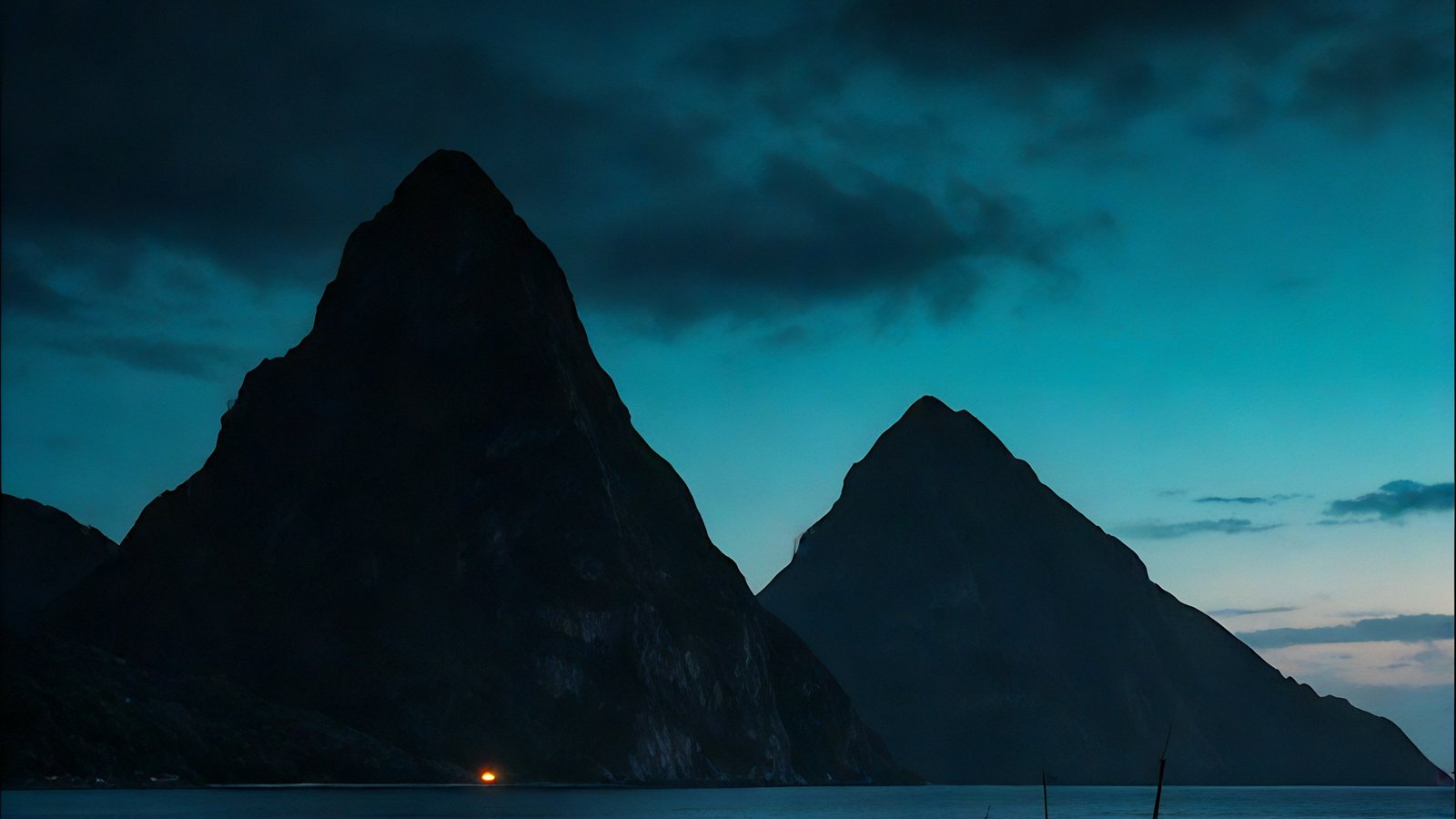
St. Lucia is real. The Pitons are real, two green volcanic spires going straight up out of the sea on the southwest coast, the kind of thing that ends up on a postcard whether the island wants it to or not. The Kwéyòl is real. The French place-names sitting on top of an English courthouse are real. Jounen Kwéyòl in October, with the madras cloth and the cocoa tea, is real.
Bellefond is not. I made it up.
It's a small fishing town on the west coast, and I named it Bellefond because the word means something close to beautiful depth, a lovely surface over dark water, and I am apparently not subtle. There's a reason I invented a town instead of borrowing a real one. When you write crime, you put terrible things in people's mouths and worse things in their pasts, and I wasn't willing to do that to a real place with real neighbors in it. So I built Bellefond on the bones of a real island and let the fiction live in the town.
What hooked me was the engine underneath the whole series. There are two economies in a place like this, sitting in the same bay, pretending not to see each other. There's the fishing co-op, the pirogues hauled up on the sand, the men who've worked that water since they were boys. And there's the marina: the white hulls, the all-inclusive resort eating the coastline one parcel at a time, the money that flows around all of it and into pockets nobody can name. The postcard is for one set of people. The other set pays for it.
The sea runs through everything. It feeds the town and it drowns the town's secrets and, every so often, it gives one back. Bellefond is where all of that touches. The beauty is real and the rot is real, and the book refuses to pick one.
Meet Séraphine
She's an investigative journalist. Late thirties. She was born in Bellefond and left at eighteen, the way a lot of bright island kids leave, for the UK, for a career, for newsrooms where nobody asks where Soufrière is. She built a real one. And then she came home for a funeral and never left again.
The funeral was her sister's. Marise drowned. The island ruled it an accident, sea and rum, the easiest sentence anyone ever wrote, and Séraphine has never believed a word of it. That's the premise. It isn't a spoiler; it's the ground the whole series stands on. A woman comes home to bury someone she loved, doesn't accept the story she's handed, and starts asking quiet questions in a place where everybody already knows her name.
Everyone on this island tells Séraphine the truth. That's how she finds the lies.
That line is the closest thing the series has to a thesis. She's the woman the whole parish brings its troubles to, the one people confide in, the one they tell things they shouldn't. Her warmth is genuine. It's also the most dangerous thing about her, because when everyone tells you the truth, the lies are the only things that stand out.
She speaks perfect English most of the time. That's her armor, the polish she earned in those English newsrooms. But when she's frightened, or grieving, or talking to an old woman who knew her grandmother, the Kwéyòl comes up through it before she can decide to let it. She catches it after, never before. I love her for that. She's a person who left and a person who belongs at the same time, and her own mouth keeps proving she can't fully be either one.
And then there's Marise, who is dead before page one and somehow the most alive person in the book. I refused to let her be a body and a motive and nothing else. She was a reporter too, a good one, patient in a way her younger sister isn't, and she left a carton of school exercise books full of notes that Séraphine reads the way you'd read a letter from someone you weren't done talking to. You'll meet Marise in the margins of her own handwriting. By the end of the series, you'll feel like you knew her.
I write a lot about people who are two things at once. Séraphine might be the most fully two-things character I've ever put on a page.
Why a journalist, and why she gets to travel
A confession about craft, because some of you like this part. The hardest problem in a series like this isn't the murders. It's standing. Why does a woman from one small St. Lucian town get to land on Dominica, on Trinidad, on Barbados, and have doors open for her? A random stranger asking questions about a dead body gets shown the door, fast.
So Séraphine isn't random. She's a founding member of a small pan-Caribbean reporting collective, a network of journalists scattered across the islands who share contacts, share a story budget, and cover for each other when it counts. It gives her a reason to be everywhere, a phone number that gets picked up in four countries, and a kind of authority that has nothing to do with a badge. She has no arrest power. What she has is the story. And in the end the story going out is its own kind of consequence, sometimes the only one available to her.
It also means she isn't alone, which matters more than it sounds. A recurring protagonist needs people to come home to, and Séraphine has a whole parish of them: an old aunt who is aunt to half the town, a tired police officer caught between what he knows and what he's allowed to write, a co-op full of men who watch the water for a living.
Five islands, one thread
Here's the shape of it, and this is the part I get to brag about, because I'm proud of it.
Each book is a complete crime novel set on a different island. You can start anywhere. Each one is its own case, its own culture, its own kind of crime, and it resolves by the last page. No cliffhanger holding your next purchase hostage. I hate that trick. I won't do it to you.
But underneath the five separate cases, one thread runs through all of them. Something Marise was chasing when she died. Each island Séraphine travels to turns that thread a little further, and the last book brings the whole tour home to St. Lucia for the reckoning.
- St. Lucia is home, and where it starts. Saltwater.
- Dominica, the Nature Island. Rainforest, the Kalinago Territory, a disappearance in country that swallows people whole.
- Trinidad at Carnival. A murder hidden inside the biggest, loudest crowd in the Caribbean.
- Barbados, Little England. Great houses, cricket-club manners, and an "accident" that is anything but.
- St. Lucia again, home seen clearly this time, the end of the thread and the truth about Marise.
Five islands that are nothing alike. That was the whole fun of it. I got to write five different versions of the Caribbean, five different histories, five different ways a place can wear the conquerors it never chose. St. Lucia changed hands between France and Britain more than a dozen times; it still speaks a French creole under an English court. Barbados kept its Englishness so long it called itself Little England, and only just dropped the Crown. Each book is a love letter to a real island and a crime against a fictional version of it.
I'm writing them in first person, past tense, which is new for me. I usually live behind a close third. But Séraphine narrates her own life better than I ever could from the outside. The voice is hers. I'm just the typist.
On writing a place that isn't mine
I'll be straight with you, because you've earned it. I am not Caribbean. Writing Bellefond meant doing the work: reading, listening, checking, and then checking again, and handing the most sensitive material to people who are from these places before any of it goes near a shelf. The Kwéyòl in these books is never spelled out phonetically like a costume, never footnoted, never dropped in for flavor. It's there because that's how people actually move between two languages inside a single sentence. Obeah is treated as lived practice, not a horror prop. The Kalinago characters in book two have their own goals and their own voices, not the magical-guide nonsense the genre keeps reaching for.
I won't get all of it right. I know that going in. But the alternative was flattening five distinct islands into one generic "tropical" backdrop with a body on the beach, and that felt worse than trying and being corrected. So I tried. The corrections are welcome, and a few of them have already made these books better than I could have made them alone.
If you love this kind of book
You know the writers I mean. The ones who can make a place so specific it turns into a character. S.A. Cosby, where the beauty and the corruption of a town are the same thing. Louise Penny, who built a whole world readers return to year after year because of who lives there. Attica Locke. Kwei Quartey, threading an investigator through a culture rendered with real care.
That's the shelf I'm reaching for. Atmospheric crime, thriller-paced, soaked in a place, anchored by a person you'll want to follow for a long time. Dark, but never bleak for the sake of it. There is warmth in these books. The warmth is the whole point; it's what makes the dark land when it lands.
If that's your shelf too, I think Séraphine is going to feel like someone you already know.
What I'm asking you for
Now the part I'm nervous about.
I'm starting this series almost from scratch. Bellefond is a new world under a part of my name that doesn't have the readership my other books do, and the honest truth is that the people who hear about Saltwater first are the ones who help it find everyone else. Launch week is everything for a book like this: the first readers, the first reviews, the first quiet word passed to a friend. I would rather build that with you than buy it from strangers.
So here's the ask, and it's a small one. Join my newsletter. That's where I'll send the cover reveal, the first chapter when it's ready, the release-day reminder so the date doesn't slide past you, and the behind-the-scenes pieces I'm already itching to write: the real Caribbean settings, the research rabbit holes, the way these five books lock together. No spam. No daily noise. Just me, telling you what's coming and when.
If you've read this far, you're exactly the reader I wrote this for. Come along for the start of it. I'd love to have you in the boat before we leave the bay.
November 18. Saltwater. I'll see you on the water.