
Character Dossier: Thaelon, Immortal Watching from the Wall
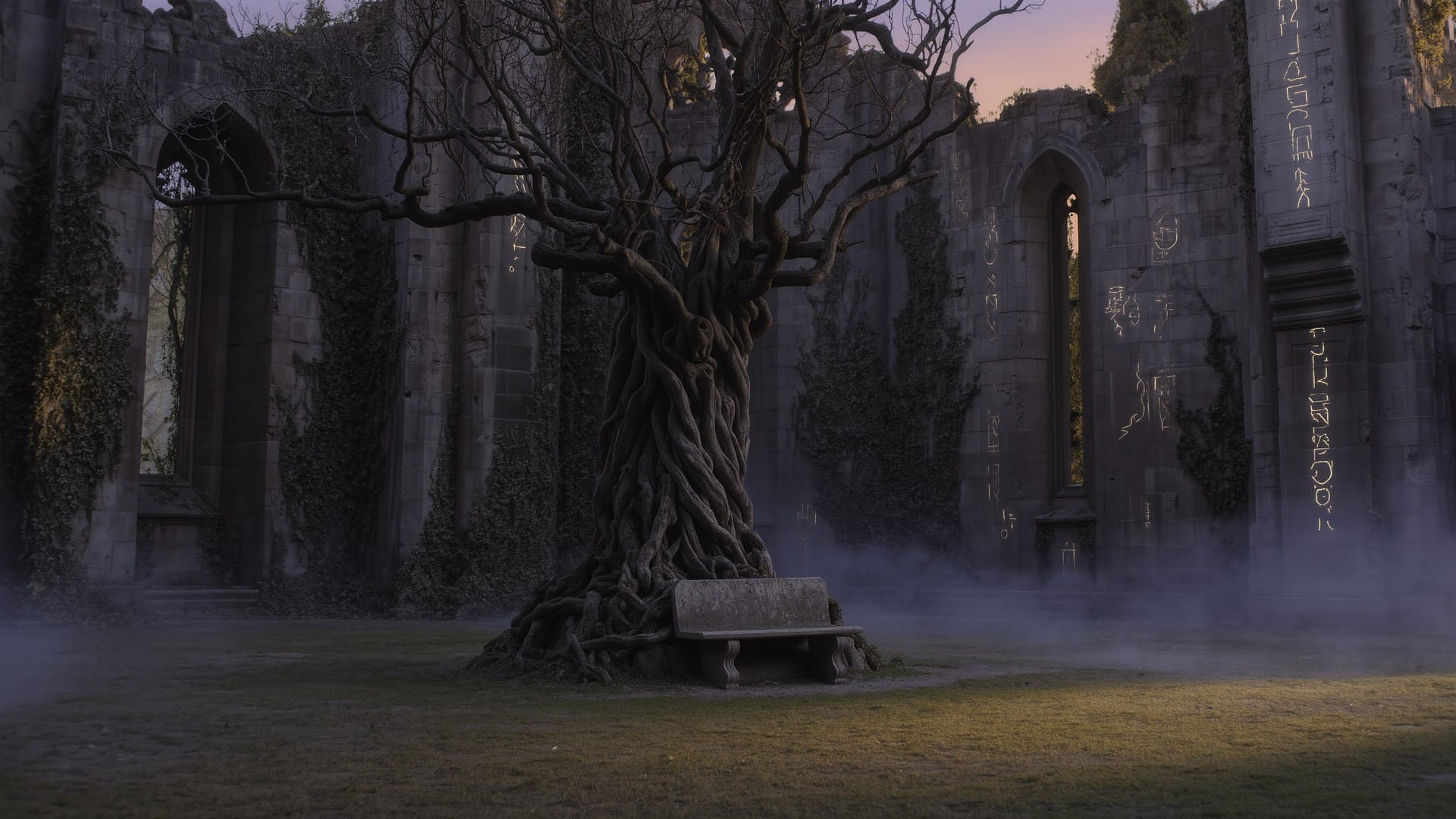
Thaelon leaves a reader with questions.
Where does he come from. What did he do before he met her. Did he know, the night of the ball, that this was the one. Why does he wait. What does he do, in the Eternal Garden years, when she is asleep. Is he going to be all right after.
The books answer more of those than a first read lets on, and this dossier gathers what they say. Some of these spoilers are mild. Some assume you have finished The Eternal Garden. If you haven't, save this for after.
I. His Name and His Titles
The books give him titles rather than a hidden name. The Queen Regent calls him "Thaelon of the Eastern Reaches" in front of her whole court. The Court's record names him "Prince Thaelon, fourth son of the Verdant Throne." Elsewhere he is simply "Lord Silverwind."
Thaelon is the name his mother used. Among the things he keeps from his childhood is the sound of her voice, calling from the terrace above: "Thaelon, stop climbing the aqueduct."
He is an elf: pointed ears, silver hair, elven blood that runs cooler than human. And he did not leave his people by choice. "Your people exiled you," the Queen says to his face, and she names him before her court: "The kinslayer. The oathbreaker." An elf who has survived six hundred years of exile knows how to vanish, and when he needs to, he does.
II. The Centuries Before the Ball
Thaelon is, when Twin Lives begins, six hundred years old. "I have lived six hundred years," he tells Adeline, and he has, in his own words, "fought in wars humans do not remember, and seen plagues of sword and disease and madness." He has seen the Primordial seals forged and the First War fought.
He was raised for a court. He studied diplomacy under his father's advisors, and the political awareness he learned there became, in time, his primary skill.
He has been in love three times before Adeline, and he has watched all three women grow old and die.
The first the books name is Veris, a half-elven cartographer. "She had been mapping the southern coast for me," he tells Adeline in The Frozen Wastes. She died in the third century of his life, of a fever that nothing in mortal medicine could treat then. "I had loved her. I had not said so." He gave the speech at her pyre. After Veris he stopped taking lovers among mortals, then among the half-elves, then at all.
Another was Mirielle, a court musician, human and young, who played the ael'haris, a stringed instrument that takes decades to master, and mastered it offhandedly. He remembers the final morning clearly. In the Crystal Gardens he planted violet crystals in the year that Mirielle died, and in a small wooden box he still keeps a lock of her dark hair.
The third the books leave unnamed. "Mirielle and the others he'd loved and lost" is as far as he goes.
So: three loves, and three funerals he did not get to skip. By the night he walks into the Queen Regent's ball in Thornhaven and goes to one knee before her throne, he is, against every reasonable instinct, ready.
III. The Ball
Twin Lives tells that night from Adeline's side of the room. The doors slam open. A tall, cloaked figure stands in the doorway, announced with "No name, and no title." He crosses the marble to the throne and goes to one knee without catching himself on his hands. He has come to ask for help for his people, and the Queen gives him none: she names him, the kinslayer, the exile.
Adeline pulls free of Thomas Fairfax and calls out to the throne: "Your Majesty. If his people are dying, shouldn't we at least hear what he needs?" He looks at her across the marble and inclines his head, once.
Then the Queen has him removed. From the balcony Adeline watches him led out through the gate in chains, silver hair catching the firelight. He pauses, turns and looks up at her, and mouths one word: "Please."
Neither of them waits six weeks. Three nights after the ball she goes down to the docks, to the Broken Crown, where everyone in Thornhaven knows the elves go and no one says it. "Three nights, and no one came," he says. "I came," she answers. Six weeks after the ball, they are already on the road together.
The Bonds of Power gives the same meeting as he remembers it, with every detail preserved "with the obsessive precision of someone who knew, in the instant of experiencing it, that this moment mattered." In his memory the ballroom is in Elendale, and he is there only because attendance is required. "He stood near the wall. He held a cup he had not drunk from." Six centuries of reputation will create a perimeter, and nobody crosses it until she walks toward him. "You're Thaelon," she says. Not a question.
The two tellings do not agree on the room. They agree on what matters: she came to him, and he has kept her face ever since. Later in Twin Lives, when a working opens him to her, she feels what she is to him: "He remembered her face."
IV. His Magic
Thaelon is a warrior. "An immortal warrior," he says of himself, beside "a human woman barely into adulthood." His magic is a fighter's: words of power already on his lips at the Nexus, and in The Shattered Veil his void magic flaring into barriers that catch their blades.
He is also an elf who remembered every moment of six centuries, which in The Bonds of Power makes him, before Adeline, "the elf who remembered everything and connected with nothing." His oldest memories he keeps in elven crystal: "a crystal memory-sphere, no larger than a plum," one of his crystalline memory-stores, whose contents surface when he closes his eyes and lets them.
This matters to the series in two places.
In Twin Lives, at the Nexus in the Shadowpeak Mountains, the seal takes Cordelia as its living anchor. "Me," she says, steadily. "The living anchor. What I came here to do." Thaelon springs across the platform with both hands out toward her, and it is not enough: "His magic hit the amber light and rebounded, throwing him backward." When Cordelia offers, in The Shattered Veil, to merge with a Primordial, he is the one who tells her, gently, "You cannot simply volunteer for this."
In The Bonds of Power, the bonding ceremony opens a channel between his mind and Adeline's, and it lets each partner choose what to reveal and what to withhold. Thaelon considers holding something back for approximately three hours before discarding it.
V. The Bond
I have written about the ael'tharis, the elven soul-link, in the world-lore post. The thing that belongs in Thaelon's dossier is what the bond does to him.
He is the one for whom this is unprecedented. Adeline is human, and even the bond's extension of her lifespan will buy her decades, not centuries. Thaelon has outlived everyone: his parents, his childhood companions, three successive courts, two political orders, and Mirielle. The bonding will not make Adeline's death easier; it will make it far harder. He is afraid of it, and he refuses to let the fear decide.
When he asks her for the bond in The Bonds of Power, he is honest about what it buys. It shares his vitality with her: "Not immortality. Not even close. But decades, perhaps. Enough to —" His voice catches, and he looks down at their joined hands. "Enough to matter."
She says yes before he has finished asking. The morning after, he walks the Crystal Gardens at dawn and stops at the violet crystals he planted for Mirielle, and the fear comes with him, and he lets it.
That is the bond, for him. Not the empathic channel. Not the dreaming. The decision, made with eyes open, to let himself be the one who survives. Years later, on the bench, he says it to her plainly: "I chose you," he says, "knowing you would leave me."
VI. After
In the Eternal Garden years they sit on the bench in her garden ten thousand evenings. Her sleep grows, as she puts it, "Deeper. Longer." And yes, he watches her sleep. "I caught you watching me sleep last night," she tells him. He says, simply, "Yes."
She dies in the garden at the end of The Eternal Garden, in the morning, on the bench. "The morning opened around her." Lyra holds her left hand and Thaelon her right, and Alaric stands at the garden gate, watching.
The book does not end with her death. It ends twenty-eight years later, in the garden, where Mira's daughter is chasing butterflies. Her name is Adeline.
He keeps his promises. "Promise me you'll tend it," she asked him, and the garden grows for decades after her death, tended by Thaelon's hands and then by Lyra's and then by Mira's, and at last by a small community. He goes on much as he pictured it for her, near the end: "I see my students at the Academy."
On the last pages he walks through the gate as someone who has walked for six hundred and fifty years, and what Lyra sees in his face is "not grief. Not anymore. Grief had been the first decade."
He is, in the way only the long-lived can be, all right: there is a peace in him that has been earned through patience and time.
— Elara
More from Fractured Dynasty: the Fractured Dynasty series · every Fractured Dynasty post · the world of Elendale · my Fractured Dynasty commentary
Want my next book before it comes out? Join the First Chapter Club for free advance copies. I send a letter when a book is coming, when there is something worth sharing, and never more than that.