The World of Fractured Dynasty: Elendale, the Soul-Bond, and the Seals That Keep Failing
The World of Fractured Dynasty: Elendale, the Soul-Bond, and the Seals That Keep Failing
There are nine novels in Fractured Dynasty and one prequel, and behind them sits a world I drew before Adeline ever stepped into a ballroom. Most of it never made the page. It lives in the margins of a notebook labelled Aerthen — do not lose, in dynastic registers I keep on a hard drive I am too superstitious to clean out, in a hand-drawn map where the scale was always wrong and the Dead Zone kept moving.
This post is the room behind the curtain. If you finished The Eternal Garden and still wanted to know how the Seven Seals were actually built, or why the Twilight Folk speak the way they do, or what the Primordials are under all the church language — pull up a chair.
I. Elendale and the Human Kingdoms
The world of Fractured Dynasty has two centres of gravity, and Adeline begins her life in the wrong one.
Elendale is the elven city. Built in a valley the human kingdoms call the Singing Vale and the Twilight Folk call by a name that translates approximately as the place that listens back. Its towers are not stone in the way human towers are stone. They are grown — slowly, over centuries, from rootwood and a kind of luminous ore the elves do not export — and the city's geography rearranges itself by inches over decades, the way a forest does. By the time Adeline first sees Elendale at twenty-three, the city she walks into is not the same city Thaelon left a hundred and seventy years before. The west archive is now in the south wing. The gold chamber is taller. He notices. No one else does.
The human kingdoms are nine, but only five matter to the series. Vaelmoor is Adeline's birth kingdom — a coastal monarchy with a court that takes itself very seriously and a queen who had the good sense to die before the events of book one. Tharant is the kingdom that absorbs Vaelmoor's Council seat after the shadow plague years; the marriage Adeline almost makes there in her early twenties is the one that almost prevents the entire series. Korvane, Mereth, and the Free Holdings of the eastern ridge are the political weather of books three through five — the Awakened persecutions begin in Korvane, the first Primordial church is founded in Mereth, and the Free Holdings are where the Anchor Coalition recruits its first true sympathisers.
The Council of Realms — which Adeline ends up chairing after The Shattered Veil — was a Stormpact creation, drafted in the immediate aftermath of the first apocalypse to give the human kingdoms and the Twilight Folk a shared room to argue in. Twelve seats. Six human, six non-human, and a chair vote that breaks ties. Adeline holds that chair vote for thirty-seven years. Her replacement holds it for nine. Her replacement's replacement is still holding it when Thaelon is reading by the garden wall in The Eternal Garden.
II. The Twilight Folk
The elves are not the elves of any other fantasy you've read. I worked hard at that.
The Twilight Folk are a single people split across three territories — the Vale (Elendale and surrounds), the Frozen Wastes north of the Scar, and the deep-island archives of the southern sea. They share a language, a memory tradition, and a cosmology in which time is not a line but a tide. They live, on average, between eight and twelve hundred years. They do not call themselves immortal. They are long-lived, and the distinction is the moral spine of the entire Thaelon arc.
A long-lived person who watches mortals love and die over centuries is not a god. They are someone who has learned, through repetition, that grief is survivable. Thaelon's tragedy is not that he is immortal. It is that he is a being for whom love has, for hundreds of years, been a temporary condition. Adeline is the human who breaks that pattern, not because the bond makes her live longer (it does not), but because for the first time in his life Thaelon does the math forward instead of backward. He doesn't grieve her in advance. He decides, at the bonding altar in The Bonds of Power, to spend her lifetime as a finite resource — and the rest of his own as something he will figure out later.
The Twilight Folk's politics are also more complicated than a single Council representative. Their internal factions — the Stillwater school, which advocates strict isolation; the Vale Council, which Thaelon nominally serves; the Frozen House, which in book two becomes the unwitting host of Kessarax's first awakening — appear in dispatches throughout the series, and each of them gets a sentence or two whenever a major decision requires their assent. The Vale Council is mostly off-page because Thaelon is the only Twilight Folk character with a major interior life on these books. That is intentional. The Twilight Folk are not the protagonists of this story. Adeline is.
III. The Soul-Bond
Here is the rule I locked down before book one: the soul-bond does not extend a mortal life.
I had to lock that down because every fantasy romance with an immortal love interest eventually has to face the lifespan problem, and I wanted Fractured Dynasty to face it without flinching. The soul-bond — the vael'arani, in the older Twilight tongue — does three things. It opens a steady empathic channel between two souls. It allows shared dreaming during deep sleep. And it makes the surviving partner, after the first one dies, profoundly able to feel the other's absence, like a hand reaching into a coat pocket for a key that is no longer there.
That is all it does. It does not extend her life. It does not let him die with her. It does not give her any of his magic. The Twilight Folk who perform the vael'arani are very clear with both partners about this, and the ceremony in The Bonds of Power — which is the first time we see one performed on the page — includes a section the cult-faction in The Bonds of Power tries to weaponise, where the bond-officiant says the words "and you will outlive each other in different ways."
The political flashpoint around the bond ceremony is what Arc Two turns on. The Primordial churches argue that vael'arani is a sacrilege — that mortal souls were meant to remain unbound — and that the soul-bonded are an offence against the cosmic order. The Anchor Coalition, building toward something larger, exploits this. The Coalition's actual goal is not religious. It is to free the Primordials. The bond ceremony is the recruiting symbol they use to drive the persecutions that draw their footsoldiers in. By the end of The Gathering Storm, the bonding altars are being burned. Adeline's response — to perform the ceremony in public, on the steps of the Council Chamber, with every camera-equivalent in the kingdom watching — is the moment the political war becomes personal.
IV. The Seven Seals and the Primordials
The Primordials are cosmic titans. They are not gods. They are cosmological constants, beings older than the world, who were imprisoned at the world's founding by the Seven Seals — geographic anchors set at points where the membrane between worlds is thin.
This sounds like a lot of fantasy you have read. The trick is what they are for.
The Primordials, in this cosmology, are not evil. They are unbalancing. Each of them embodies a force that, if released into the world, would tip the balance permanently — toward stasis, toward chaos, toward unending growth, toward unending decay. The Seven Seals were not built to keep monsters out. They were built to keep the balance. Imagine a pendulum: the Primordials are the weights at either end. Removing one does not free the world. It sends the pendulum into a permanent swing.
This is why the philosopher in Arc Two — Vaerith, who does not appear on the page until book five but whose writings are quoted from book three onward — can argue with a straight face that freeing the Primordials would liberate the world. From his perspective, the Seals are a cage. From the perspective of every culture that has ever lived inside the cage, the Seals are the floor.
The Seven Seals are at: Shadowpeak (the original Nexus), the World Axis (north pole), the Drowned Library (under the southern sea), the Frozen Heart (centre of the Scar), the Hollow Mountain (a volcano in dragon territory that is not, technically, a mountain), the Eastern Gate (a mountain pass on the Korvane border), and the Living Stone (a cathedral-sized geode in the deep south that Adeline never visits in person and which is the only Seal she does not personally restore).
In The Shattered Veil — book six — five of those Seals are failing simultaneously. The choice Adeline makes at Shadowpeak, where her friend Cordelia volunteers to become the new anchor for the original Nexus, is the moral hinge of the entire series. Cordelia is not killed. She is bound. She is alive in the Nexus for the rest of the books, and Adeline visits her, and they have conversations across a thinning wall, and the kindest thing Cordelia ever does is to refuse to let Adeline trade places with her.
V. Dragon Territories, the Dead Zone, the World Axis
A complete world needs places that are not for people.
Dragon territories lie south and west of the human kingdoms. Three sovereign dragon-clans, each with its own internal politics, who tolerate the human kingdoms because the alternative is too tedious. The dragons in this series are not ridden. They are diplomats. The treaty Adeline negotiates with Kessarax in The Gathering Storm is the most consequential off-page political accomplishment of the second arc, and Kessarax — who is ten thousand years old and bored — becomes the only character in the series with a longer view than Thaelon's.
The Dead Zone is the consequence of the first apocalypse. A region the size of a small kingdom, between the Scar and the Eastern Gate, where the shadow plague was densest. Nothing grows there now. Caravans cross it because they have to. The Dead Zone moves — slowly, by inches each year — and the Council's geographers maintain quiet maps that no one in Tharant or Mereth is allowed to see, because if the public knew the Dead Zone was expanding there would be panic. By Arc Two it has stopped expanding. By the end of The Eternal Garden it has begun, very slowly, to retract. The land remembers.
The World Axis is a place, not a metaphor. A pillar of upthrust stone at the geographic north pole, around which the whole continent is arrayed. Adeline goes there once, in The Shattered Veil, in a sequence I rewrote four times because the scale kept failing me. The Axis is the largest of the Seals — it anchors the Primordial of Stillness — and standing at its base, Adeline experiences for the first time a sense of being not at the centre of the story but at its hinge. That sense never quite leaves her. By The Eternal Garden it has translated, in her old age, into a deep capacity for stillness in her own person. She writes by candle. She tends her plants. She lets the world turn around her.
VI. What I Cut
A complete cosmology should mention what didn't make it.
There was a sea-faring culture in the western archipelago that I had named, mapped, and given a magic system to. They were going to be the protagonists of a parallel arc in book five. I cut them because the book was already long enough without an entire fleet showing up to argue about the Seals, and a glimpse of them in Vaerith's writings did the work the full subplot would have done.
There was a Primordial — the ninth — whose Seal had been broken before the events of the series. Most of what we now call the Twilight Folk was, in early drafts, the legacy of that breaking. I cut it because the Twilight Folk worked better as a people in their own right than as the spillover of a cosmic event. Some of that early lore survives in Thaelon's references to the Long Memory — a phrase that, in the published books, is just a name for a school of elven historiography, and in my drafting folder is a small private apocalypse the world barely survived.
There was, briefly, a magic system based on weaving. I cut it because it duplicated the bonding cosmology and made the Primordials less coherent. A shadow of it survives in the soul-bond's empathic channel.
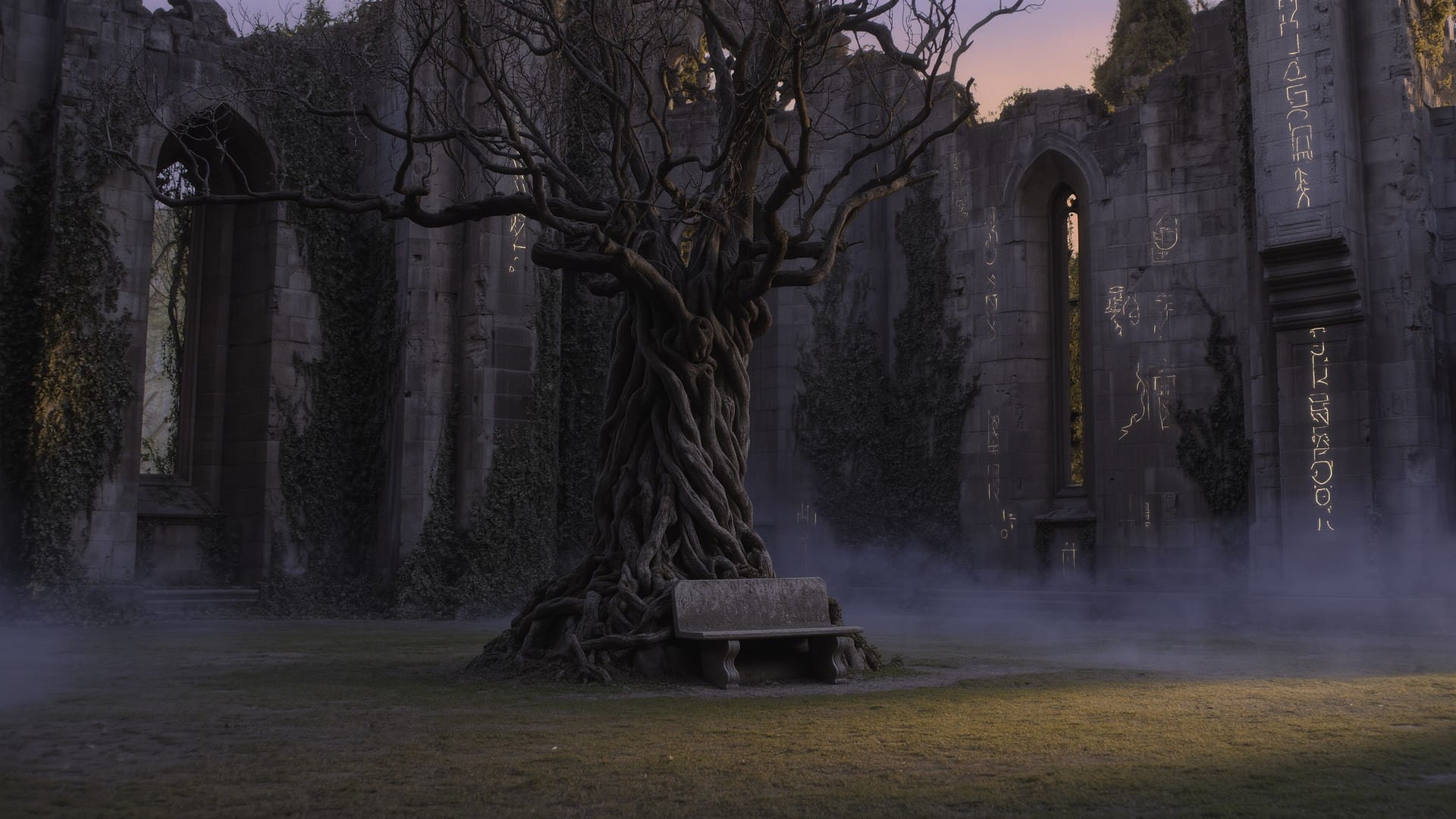
For now, this is the world. Old, balanced, almost lost twice, and finally laid down in a garden with a stone bench and an immortal man who has, at last, learned how to be still.
— Elara