Writer's Commentary: Why I Wrote a 157-Year Love Story
I started Fractured Dynasty in a year I do not particularly want to revisit, and I started it for a reason I did not understand at the time and only barely understand now. The honest answer to what is this series about, underneath the plot is the question I have been afraid of in my own life. So this commentary is going to be more personal than the other behind-the-scenes posts. If you came for plot trivia, the cuts are at the bottom. If you stayed, fair warning.
I. Why Immortality
The first idea I had for the series was not the ball. It was the garden.
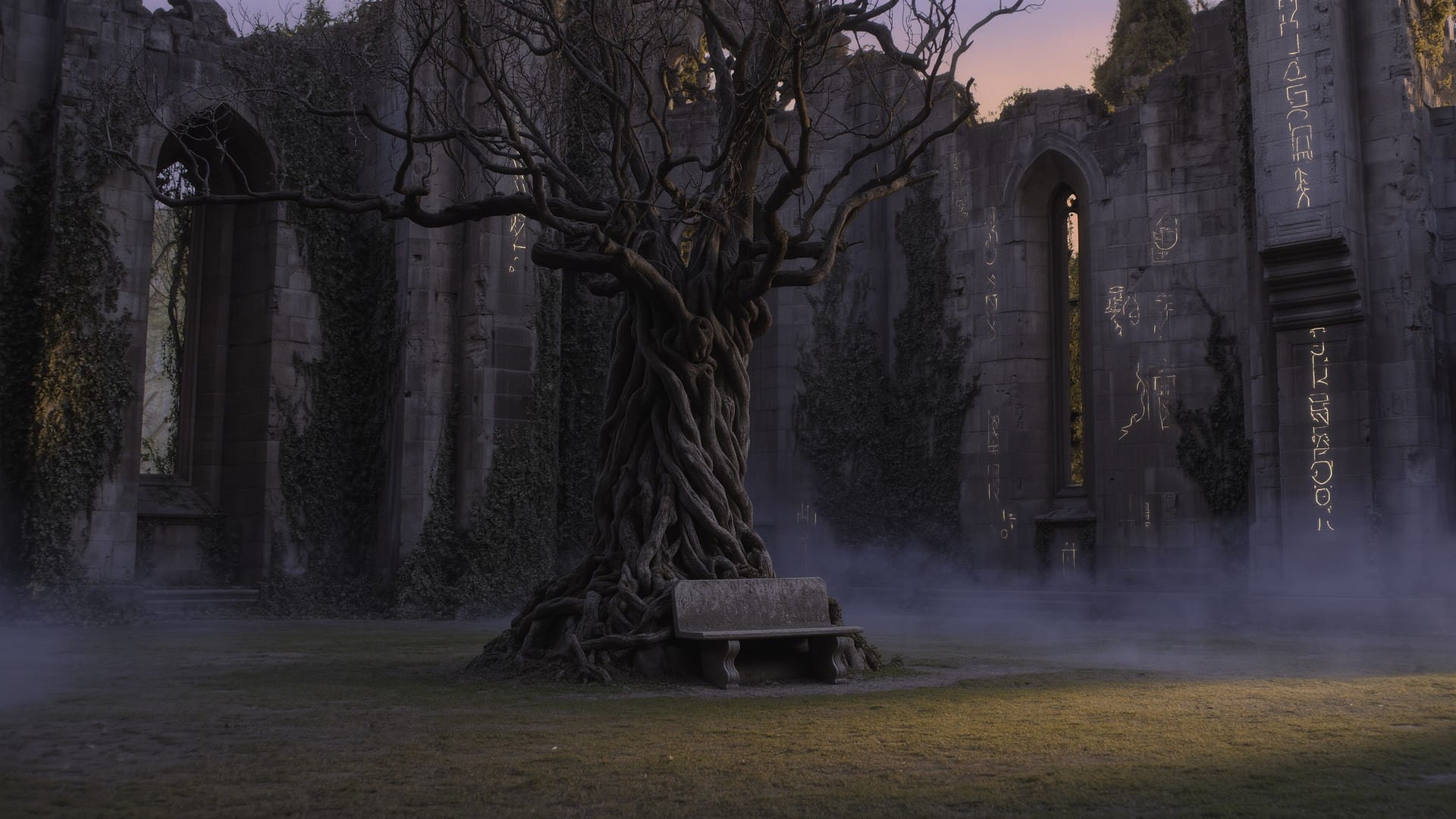
I had a clear image, before any of the characters had names, of an old woman on a stone bench, and a man beside her who was not old. They were not talking. The light was coming in over a wall. She was tired in the way people are tired at the end of a long life that has been mostly worth it, and he was holding her hand, and he was going to outlive her by six hundred years.
I wrote that scene, badly, the first week. I have rewritten it eleven times since. The version that ended up in The Eternal Garden is, I think, the eleventh. Every other scene in the nine books was written backward from that bench.
So the answer to why immortality is: I wanted to write a love story in which the asymmetry was the entire point.
I have read a lot of fantasy romances with immortal love interests. Most of them, when they are honest, eventually have to face the lifespan problem, and most of the books I admired — most, not all — solved the problem by giving the mortal partner some path to extension. A bond that grants longevity. A blood-sharing. A divine intervention. A magical exception. I understand why those solutions exist. They are kind. They are, in their way, what the genre often wants.
I did not want to write that book. I wanted to write the book in which the bond does not extend her life, and they both know it from the beginning, and they choose each other anyway.
That is the spine of Fractured Dynasty. Everything else — the seals, the Primordials, the Council of Realms, the Korvane persecutions — is the world that allowed me to ask, across nine books, what does it cost to choose a finite life with someone you love when one of you is not finite. The answer turns out to be: it costs everything, and it is worth it, and you do not get to keep it.
II. Why 157 Years
The number was not the point. The years were the point.
I needed Adeline to have a long mortal life. Not a tragically short one — that would have made the bond's asymmetry too cheap. I needed her to have a full life, the kind where she becomes a different person three or four times, where she rules and then steps down, where she fights wars and then governs the peace and then retires from that too. I needed her to grow old in the bond. I needed Thaelon to watch her become a person he could not have predicted at twenty-three, and then a person he could not have predicted at sixty, and then a person who was, at one hundred and forty, mostly somebody he had built a life next to and was now letting go of.
The hundred and fifty-seven came out of the calendar. Adeline begins Twin Lives at twenty-three. She dies in the early morning at the end of The Eternal Garden at one hundred and eighty. The Council Chair years are between fifty and eighty-seven. The retirement begins in earnest in her late nineties. The garden takes the rest. Thaelon spends the same years beside her, but the years pass differently for him — he ages roughly seven percent of the rate Adeline does, which is a calculation I made for the magic system on a piece of grid paper at my kitchen table and have never released, because the calculation is more useful as a feeling than as a number.
What you feel, by The Eternal Garden, is not the math. What you feel is that she has been growing old for a long time and he has barely noticed it on his own face and has noticed nothing else.
III. Why She Doesn't Die in a Throne Room
I get asked this a lot, in different forms. Why does she retire. Why doesn't she die saving the world a third time. Why does the last book have so few sword fights.
Because the series was never about saving the world.
The series was about what happens after you save the world. Twice. With a friend bound into a cosmic anchor and a kingdom you no longer recognise. The plot of Arc One is a story I knew how to write — the chase, the love, the first apocalypse, the win. The plot of Arc Two is a story I had never quite written before, which is the story of governance. Adeline spends three books learning that ruling peace is harder than surviving war, and the price she pays for that lesson is most of her early thirties and her relationship with her brother and a hundred and forty thousand night hours she did not get to spend with the man she had bonded.
The retirement, in The Eternal Garden, is not a softening. It is the thesis. The thing the series argues, all the way through, is that the heroic life and the well-lived life are not the same life, and at some point a person has to choose which one to finish out as. Adeline chooses the garden. She chooses ordinary mortality. She chooses to be a person who is not the Council Chair, not the woman who restored five Seals, not the wife of the centuries-old elf — she chooses to be someone who tends rosemary and writes letters to her grand-niece and falls asleep on a stone bench in the afternoon.
She earns that. The earlier books pay for it. That's why I needed the seal restorations, the war, the long political middle. The Eternal Garden only works as a quiet book because eight loud books made it possible.
IV. The Slow Burn as a Discipline
I have written, in interviews, that the slow burn in Fractured Dynasty was a discipline rather than a choice, and people sometimes ask me what I mean by that. What I mean is that the bond ceremony is in book four, and they do not consummate the romance physically until book three, and the first kiss is most of the way through book two, and there is a non-trivial sense in which Thaelon does not fully let himself love her until book six.
The discipline is: every time I wanted to bring them together, I asked myself whether the world had changed enough yet for the togetherness to mean what I needed it to mean.
A romance arc across nine books is a long arc. Most readers, including me when I am reading other books, want the protagonists to be together. Most readers will accept "they are together but the world keeps tearing them apart" as a perfectly serviceable extended-romance structure. I needed to write the harder version, which is "they are not yet together because they are not yet ready for each other." Adeline at twenty-five is a different person from Adeline at thirty-one. The Adeline who can stand at the bonding altar in The Bonds of Power is not the Adeline who walks into the Vale at the end of Twin Lives. Thaelon at four hundred and twelve is a different person from Thaelon at four hundred and eighteen, after he has watched her almost die three times and chosen, repeatedly, to be honest with her instead of protective.
The slow burn is not a tease. It is the thing that earns the bond.
V. Cordelia
I owe a paragraph here. I get more letters about her than about anyone except Thaelon.
I did not know, when I started Twin Lives, that Cordelia was going to become the anchor at Shadowpeak in book six. She was a side character in the first outline. She was Adeline's most-trusted friend, the one who follows her into the Frozen Wastes in book two, the one who sits up with her after Kael is found, the one whose laugh in The Bonds of Power is the one Thaelon committed to memory. By the end of The Frozen Wastes, I had fallen in love with her, and by the end of The Waking World I knew she was going to volunteer at Shadowpeak, and I spent the next two books trying to find a version of book six in which she did not.
There isn't one. The Seals had to be re-anchored. Adeline could not anchor them — she was the only person who could lead the political reconstruction afterward. Thaelon could not anchor them — his magic is the wrong shape for it, and the cosmology will not let me cheat. Cordelia was the right anchor because she was the one person whose love for Adeline was uncomplicated enough to survive being bound. I write that and I still hate it.
The kindest thing she does, in book six, is refuse to let Adeline trade places. The kindest thing Adeline does is accept the refusal. Their conversations across the wall in The Long Reckoning and Echoes of Chaos are the part of the series I am proudest of.
If you came to Fractured Dynasty for the romance and stayed for Cordelia, you and I are reading the same book.
VI. What I Was Afraid Of
I said at the top that I started this series in a year I do not want to revisit. The honest reason I wrote it is that I was afraid of grief.
Specifically, I was afraid of the grief that comes from loving someone whose timeline does not match yours. Most of the people I love are mortal at the same speed I am, and that is a kind of mathematical comfort I had not appreciated until a stretch of years in which several of them turned out, briefly, not to be on my schedule. I am not going to explain that. I will just say: I needed to write a book in which the asymmetry was permanent, and the love survived it, and the surviving was not heroic. Not transcendent. Not sublime. Just possible.
Thaelon is, in that sense, the version of me I needed to write toward. The Twilight Folk live with grief without grief defining them. They have done it for centuries. Watching Thaelon practice the small ordinary discipline of not being undone by Adeline's mortal pace was, for me as the writer, a way of practicing something else. I do not think I have entirely learned it. I think I am closer than I was nine books ago.
The garden ending was always the answer.
You spend your finite years tending what is in front of you, and you let the people who love you let you go without trying to make them carry you with them. You die in your own bed, at your own pace, on a morning when the light is coming in over the wall. And the person who is staying behind keeps tending the rosemary.
That is the book I wrote. That is the book I wanted to read.
VII. Five things I cut
I keep a list. These are the five that would have made the books easier and worse.
- A version of book six in which Cordelia does not go to Shadowpeak. I spent two books looking for it. It does not exist, and publishing a fake one would have been a kindness I could not afford.
- The bond extending Adeline's life. Several early readers asked for it. It would have turned the garden into a compromise. The whole series is the refusal of that compromise.
- Adeline dying in a throne room. Dramatic. Wrong. She retires. She is tired in the ordinary way. The light over the wall only works if the death is small.
- Thaelon letting himself love her in book two, when I wanted the comfort of it. The discipline was to wait until the world — and he — could mean it.
- A last chapter from his point of view after the bench. I wrote it. I deleted it. The book ends the morning after, on the page, because grief does not get a speech from me.
If you want more of this world on the site, the Fractured Dynasty posts live under the series tag. The commentary is the why. The dossiers are the who.
— Elara