Why I Refuse to Pick Between Fantasy and Thrillers
On any given morning, I am either writing a queen on a battlefield or a woman picking a lock in the dark, and I genuinely never know which one I'll need until I sit down.
People keep telling me to pick a lane. Agents, marketing advice, the helpful corner of the internet that has opinions about author branding. Choose one thing. Be known for one thing. And I understand the logic — readers like to know what they're getting, and there's a real argument that a romantic-fantasy author and a contemporary-thriller author should be two different names entirely.
I'm not going to do it. (I'll be honest, I've tried. It lasted about a month.)
So let me make the case for refusing to choose — not as a business strategy, because it's probably a terrible one, but as a craft decision. Because the longer I do this, the more convinced I am that the warrior queens and the women with lock picks are the same story wearing different clothes, and that writing both is the only thing keeping either of them honest.
What's actually the same underneath
Here's the thing nobody tells you when you start writing in two genres: the surfaces are wildly different and the foundations are identical.
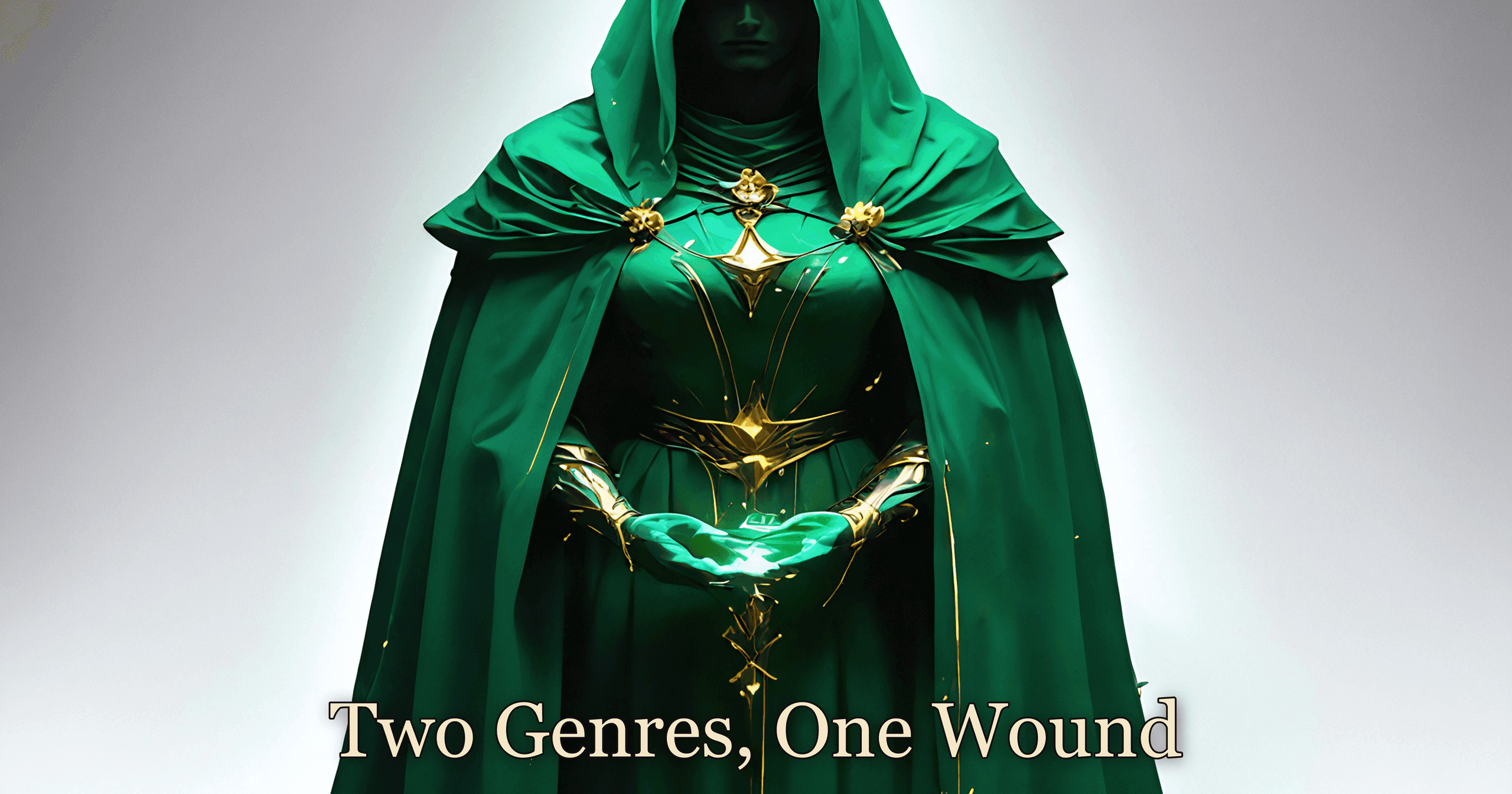
On the fantasy side, in a series like Fallen Hearts, I've got Aria Stormborn — an exiled princess reclaiming a stolen throne across three generations of war, magic, sieges, the whole epic apparatus. On the thriller side, in the Wild Flowers books, I've got a present-day woman in a world with no magic at all, where the monsters are men with money and the only weapons are nerve, patience, and a very good understanding of how people lie.
Two completely different toolkits. Swords and bonded magic on one shelf; forensics, burner phones, and the slow architecture of a long con on the other. And underneath both? The exact same question I cannot stop writing: what does a woman do when the thing keeping her alive is the thing she's most afraid of becoming?
Aria is excellent at violence and terrified of what that makes her. The women in my thrillers are excellent at deception and terrified of the same thing. Strip away the dragons and the DNA evidence and you've got one human being, under impossible pressure, making a choice that costs her something she can't get back. That's the story. It was always the story. The genre is just the costume it wears to the party.
The genre is the costume. The wound underneath is the same in every book I've ever written, and I think readers feel that even when they can't name it.

Switching genres is how I cheat writer's block
I want to be practical for a minute, because there's a real working reason I keep both plates spinning, and it's not noble at all. It's that switching genres is the best trick I have ever found for staying fresh.
When I've been deep in a fantasy world for three months — living in the politics, holding a magic system consistent, tracking who's allied with whom across a map I drew myself — my brain starts to go stale in a very specific way. The prose gets grand. Everything starts sounding like a prophecy. I'll catch myself writing a grocery-list scene like it's the fall of an empire.
That's when I switch to a thriller, and the contemporary voice scrubs all of it off. You cannot write a tense present-day scene in high-fantasy cadence; the reader will laugh you off the page. Short sentences. Real brand names. A character checking her phone. The discipline of writing now sharpens everything, and when I go back to the fantasy a few weeks later, I bring that tightness with me.
It works the other way too. Thrillers can get clinical — all plot machinery, all clicks of the lock — and a stretch in fantasy reminds me how to let a feeling breathe across a whole chapter, how to earn a slow burn over four hundred pages instead of four hundred words. Each genre is the other one's editor. I didn't plan it that way. I just noticed, a few books in, that my fantasy got tighter and my thrillers got warmer the year I started alternating, and I've never gone back.
The same scene, two voices
Let me show you instead of just telling you, because this is the part I find genuinely fun.
Say the beat is a woman realizes the person beside her has been lying to her for months. Same emotional event. Watch what the genre does to the sentences.
In fantasy, it breathes:
She had known, hadn't she. Somewhere beneath the alliance and the careful courtesies, in the place that had learned to read a room before she could read a map, she had always known. The knowing rose now like cold water through floorboards, slow and total, and she let it come. There would be time to drown later. Tonight she still had a kingdom to hold, and a traitor who did not yet understand that she had stopped being surprised by betrayal a long, bloody time ago.
In a thriller, it cuts:
She kept her face still. Counted the exits, the way she always did. He was still talking — something about the timeline, the wire transfer, the dates that didn't line up — and she nodded along like the floor hadn't just dropped out from under the last six months of her life. Smile. Ask a follow-up question. Don't let him see you do the math. She'd cry in the car. She always cried in the car.
Same woman. Same gut-punch. The fantasy version pools and floods; the thriller version clenches into fragments and present-tense survival. I didn't decide that consciously — the genre decides it for you, if you've spent enough time in it. And learning to feel that switch in my hands is, no exaggeration, the single most useful skill writing two genres has taught me. You start hearing how a moment wants to be told.
The slow burn doesn't care what genre it's in
If you've read both sides of my bookshelf, you've probably noticed I write tension the same way no matter what world I'm in. Long. Patient. Maybe a little cruel about it.
This is the through-line I'm proudest of, honestly. A slow burn in Fallen Hearts looks like a masked guardian who swore he'd never fail another Stormborn, taking a whole book to admit that what he calls penance, he means as love. A slow burn in a thriller looks completely different on the surface — two people who can't trust each other, circling a secret, every conversation a negotiation — and it is exactly the same engine. Withhold. Delay. Make them earn it. Make the reader earn it.
The trick, in both genres, is that the tension has to come from character and not from contrivance. It's easy to keep two people apart with a misunderstanding that a single honest sentence would fix. That's not slow burn, that's just frustrating, and readers can smell the cheat. Real slow burn comes from two people who have good reasons to stay guarded — a queen who can't afford to be vulnerable, a woman who survived by trusting no one — slowly running out of those reasons. The fantasy gives me sieges to pressure them with. The thriller gives me a ticking clock and a body count. The pressure is different. The patience is the same.
The research whiplash is the fun part
My browser history is a genuinely unhinged document, and I love it.
In a single week working both books, I have looked up how long a medieval supply train can sustain a besieging army (shorter than you'd think — sieges are mostly a logistics problem wearing a drama costume) and then, in the next tab, how a forensic accountant actually traces a layered money-laundering chain through shell companies. Crossbow draw weights next to the response time of a small-town sheriff's department. The symptoms of a specific poison next to the heraldry rules of a made-up court.
This sounds like a joke about my search history, and it is, but there's a real craft point inside it. Researching two genres at once keeps me honest about specificity, which is the thing that separates writing that feels real from writing that feels like a movie set. Fantasy tempts you toward the generic — a "feast," a "battle," a "long ride" — because you invented the world and nobody can fact-check you. Thrillers won't let you get away with that for one sentence. A reader who works in finance will close the book the instant your money-laundering scheme doesn't add up. So the thriller discipline drags real, checkable detail back into my fantasy, and the fantasy reminds me that all that research only matters if it's in service of a feeling. The siege logistics don't matter. What it costs Aria to know them does.
I keep a note on my desk that just says concrete. It's pointed at both books equally. The genre that taught it to me, though, was the one with the lock picks.
What readers actually ask me
I'll tell you the question I get more than any other, and it surprised me the first dozen times: which one is the real you?
As if the fantasy is the dress-up and the thriller is the truth, or the other way around. And my honest answer is that it's a false choice. (Both-sides of me, if you'll forgive the pun.) The woman who writes warrior queens believes that love is a kind of strength and that found family can outlast anything — and she's real. The woman who writes vigilantes believes that some institutions rot from the inside and that survival sometimes means becoming someone your younger self wouldn't recognize — and she's real too. I need both to write a whole person, because actual people contain both of those beliefs at the same time and don't resolve the contradiction. They just live in it.
The other thing readers ask is where to start, and that one I'll answer straight. If you want the sweep — the magic, the thrones, the three-generation saga, the slow burn over a whole series — start with Stolen Hearts and walk the Fallen Hearts road from the beginning. If you want the modern, sharp, can't-put-it-down end of me, start with Nightshade and meet the Wild Flowers. Same author, same obsessions, two completely different nights on the couch. Want to go on the journey with me? Pick whichever version of impossible woman makes an impossible choice sounds like your weekend.
So, should an author write in two genres?
Here's my real take, caveats and all.
If you're chasing a clean brand and a tidy also-bought algorithm, no. Genuinely, no. The marketing people aren't wrong that it's harder. You split your audience, you confuse the store, and you spend twice the energy building two kinds of trust. I'm not going to pretend the cost isn't real, because I pay it every launch.
But if you write in two genres because the story needs both — because you've figured out that you keep writing the same wound and the different worlds are just different ways to press on it — then I think it makes you better. It made my fantasy tighter and my thrillers kinder. It cured a writer's block I thought was permanent. And it let me stop pretending I'm only one kind of writer, when the truth is I've got a queen and a vigilante living in the same head, and most days I love them both.
That's my take on things, anyway. Now go find out which one of them is more your speed — and then, when you've finished, try the other. I have a suspicion you contain both too.
Related Posts

Why I Set Bellefond in Saint Lucia
The Second Book Problem: Why Romance Series Are So Hard to Sustain