Writing Steamy Scenes Without Cringing at Your Own Words

Why this one?
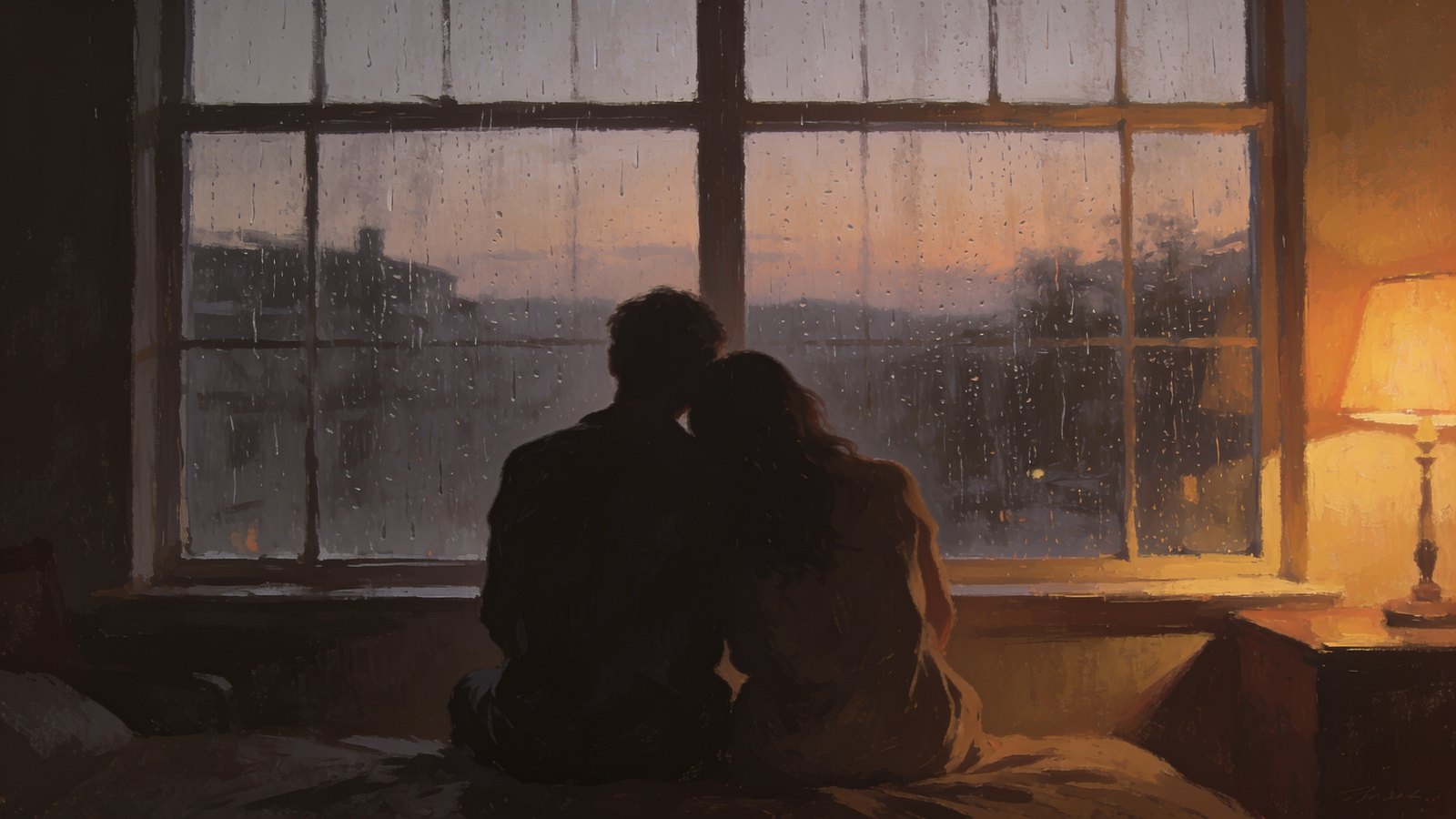
The first love scene I ever wrote, I wrote with the blinds closed. Not in the book. In my actual house. As if my neighbors could somehow read the Google Doc through the window and the siding.
I am not exaggerating the dread. I had written grief by then. A character burying her own sister. A man finding out the worst thing about himself in a hospital parking lot. None of it made my ears go hot the way typing the word collarbone with intent did. And there was the extra, very specific horror that every romance writer carries in their ribs like a second heartbeat: someday, someone I am related to is going to read this.
So let me talk about the thing nobody warns you about when you decide to write love stories for a living. Eventually, the people in them are going to reach for each other, and you have to be in the room with a keyboard and a straight face.
The fear is the whole job
Here's what took me years to understand: the discomfort isn't a bug. It's the tax you pay for writing something true.
A love scene is the most exposed a writer ever gets. Not because of the body parts — anyone can list body parts, that's a grocery receipt, not a scene. It's exposed because to write two people falling into each other and make it land, you have to know something real about wanting. About being seen. About the specific terror of letting someone close enough to actually hurt you. You can't fake that from a safe distance. You have to walk down into your own basement and bring something back up.
And readers can tell. They can always tell. They can feel the difference between a writer who is performing intimacy and a writer who is, however quietly, telling on herself. The ear-going-hot feeling? That's the sensation of telling on yourself. I've stopped trying to make it go away. When I write a scene and feel nothing, that's the one I throw out.
Nobody's spice level is the correct one
Romance has a whole rating economy now — the little pepper symbols on a graphic, "one flame" to "five-alarm," readers sorting their kindles by heat like a hot sauce shelf. And somewhere in there a very silly fight broke out about which end of the scale is the real writing.
It isn't a real fight. I'll say this as plainly as I can: a closed-door romance is not prudish, and an explicit one is not gratuitous. Those are just different promises to different readers.
A fade-to-black scene — the door closing, the cut to morning light and two coffee mugs — can be the most charged thing in a book if the longing underneath it is honest. I've read closed-door scenes that wrecked me harder than anything explicit, because the writer spent two hundred pages making me ache, and then trusted me to feel the rest in the dark. That's not a cop-out. That's a writer who knows exactly where her camera goes.
And on the other end, a fully explicit scene isn't "easier" or "less literary." Done well, it's brutally hard, because now there's nowhere to hide. Every beat has to mean something or it reads like assembly instructions.
The only actual crime is breaking your promise. If your cover and your blurb and your first three chapters tell a reader they're getting one thing, and chapter twelve hands them something miles hotter or colder than that, you've broken the contract. Match the heat to the story you actually told. That's the whole rule. Everything else is somebody trying to make their preference into a commandment.
It was never about the bodies
When new writers ask me how to write a good love scene, they almost always ask about the wrong thing. They ask about mechanics. Where do the hands go, how explicit is too explicit, what words are off-limits.
Wrong question. Every time.
The best love scene in any book is not a sex scene. It's a turning point that happens to involve sex. Something changes between two people in that scene that could not have changed any other way — a wall comes down, a lie stops being sustainable, a person who has armored up for three hundred pages finally lets themselves be soft and is terrified about it. The bodies are just where the camera happens to be pointed while the real thing happens.
I have a test I run on every intimate scene I write. I ask: if I deleted the physical action entirely and left only what the two characters are feeling and risking, would the scene still have a point? If the answer is no — if all that's left is choreography — then I haven't written a scene yet. I've written a diagram. The fix is never more heat. The fix is more stakes.
This is also, conveniently, why closed-door works at all. If the meaning lives in the emotional turn and not the mechanics, you can close the door right at the peak and the reader still gets everything that mattered. The mechanics were never carrying the scene. The wanting was.
How I actually got past the cringe
For anyone standing where I stood, blinds closed, hands hovering: here's what actually worked, none of it glamorous.
I wrote it badly first. On purpose. I gave myself permission to write the worst, clunkiest, most cringe-inducing version of the scene, with the explicit promise to myself that no human would ever see the draft. The cringe, it turns out, mostly comes from trying to be good and vulnerable at the same time, on the first try, with the door open. Take away the "be good" requirement and the vulnerability flows, and you can fix the prose later when your ears have cooled off.
Then I figured out where the camera lives. Every intimate scene is a series of choices about what you show and what you let happen offstage, and those choices are craft, not morality. Pick them on purpose. Pull in close for the beat that matters most — usually a small one, a hand, a held breath, a name said differently than it's ever been said — and let the rest blur.
Then I cut the clinical words. Not because they're dirty. Because they're cold. A word that belongs in a medical chart yanks the reader out of the feeling and into a diagram, and the feeling is the whole product. I keep the language doing the same emotional work the rest of my prose does, and I delete anything that suddenly sounds like a different, more anatomical author wandered in.
And then — this part is unglamorous and essential — I let it sit, and I edited it stone-cold sober the next morning, when I was no longer the person who wrote it at midnight with her whole heart on the desk. The midnight writer is brave. The morning editor is the one who makes it good. You need both, and they should never be in the room at the same time.
The relative is going to read it, and you will survive
Let me deal with the worst fear directly, because it's the one that closed my blinds in the first place.
My mother read my first book. I knew the scene was in there — chapter fourteen, and I could have told you the page number from memory, because I'd reread it eleven times convinced it was either far too much or somehow not enough. She came to visit the week she finished it. I spent three full days watching her face like a smoke detector, waiting for the beep.
She set the book down on my kitchen table, patted the cover once, and said, "The part in the rain was lovely."
That is the entire review. To this day I have no idea whether she skimmed chapter fourteen with the tactical grace of a woman who did not want to discuss it with her daughter, or whether she read every word and simply, mercifully, decided we would never speak of it. Both of those are gifts. The horror I'd been building for literal years lasted exactly one sentence, and the sentence was about rain.
Here's what I finally understood. The people who love you are not reading your love scenes as a referendum on your soul. They're reading a story. That lurid, judgmental imaginary audience in your head — the one leaning over your shoulder making your ears burn — does not exist. There is only your actual mother, being kind about the rain. Write for the story. The jury you're so afraid of was never even in session.
Even the quiet scenes are a conversation
One more craft idea, because it changed how I write intimacy more than anything else.
The hottest scenes are the ones where the characters are talking — not always out loud, but the whole scene is a running exchange of is this okay, do you want this, are you sure, answered in a dozen small ways. For years I assumed that kind of checking-in would smother the heat, the same way I used to think being careful and being sexy couldn't share a room. I was so wrong. The asking is the tension. A character who pauses to make sure is a character who could still walk away — and watching them choose not to, on purpose, in real time, is the entire thing.
It's the same lesson as all the others here, wearing fewer clothes: intimacy on the page is two people choosing each other with their eyes open, exits visible, no one swept anywhere they didn't decide to go. Take away the choice and you've got choreography. Keep the choice — let them make it slowly, out loud, a little nervously — and a scene where almost nothing technically happens can still leave a reader fanning herself with a paperback at a stoplight.
The smallest detail does the most work
If I could hand a new writer exactly one technique, it would be this: find the single small, specific, slightly unexpected detail, and let it carry the whole scene.
Not the obvious things. Everyone reaches for the obvious things, and the obvious things are exactly why so many scenes blur into the same warm fog. The detail that lands is the off-center one — the way he goes still for half a second before he lets himself believe it's real. The fact that she's somehow still wearing one sock and neither of them mentions it. A laugh that escapes at precisely the wrong moment and makes everything more tender instead of less. Those are the lines readers screenshot. Not because they're explicit — because they're true, and true is rarer and a great deal harder than explicit will ever be.
A whole scene can ride on one observed, human, faintly ridiculous detail that proves these are two specific people and not two interchangeable bodies. Find that detail. Guard it with your life. Cut almost anything else before you cut that.
What I tell new writers now
So, do I still cringe?
A little. Honestly, yes. The ears still warm up. I've decided that's a feature — it's my body telling me the scene has a pulse. The day I can write intimacy with total clinical calm is the day I'll worry I've stopped meaning it.
Write the scene you would want to read. Match your heat to the promise you made on page one, not to whatever the loudest corner of the internet says is selling this month. Remember that the bodies are never the point — the change between two people is the point, and the bodies are just where you happened to be standing when it happened. And give yourself the bad first draft, the closed blinds, the whole embarrassing ritual. The embarrassment is just proof you're writing something real enough to be embarrassing.
Now if you'll excuse me, I have a scene to fix in the cold light of morning. The midnight version was very brave. It is also, structurally, a mess.
That's usually how you know it's the good one.
Related Posts

Why I Set Bellefond in Saint Lucia
The Second Book Problem: Why Romance Series Are So Hard to Sustain