Why I Set Bellefond in Saint Lucia
People ask me this more than anything else about the new series, and I understand why. I am a romance writer by reputation. Most of you came to me for slow burns and warrior queens and women who hunt monsters in good coats. So when I say the next book is a dark crime novel set on a real Caribbean island, the eyebrow goes up. Why there? Why that island, specifically?
The honest answer is that I did not pick Saint Lucia on purpose. I picked it by elimination, after every other place I tried refused to hold the story.
I had the woman in my head first. A journalist who left home young, built a hard career somewhere cold and English, and came back for a death she would not call an accident. I knew her before I knew her island. And I spent a ridiculous amount of time trying to give her a hometown that fit. A fictional New England fishing port. A stretch of Scottish coast I already knew in my bones. Even a made-up island, somewhere vaguely tropical and unplaceable. That last one was the worst idea I had all year. Nowhere is the fastest way in the world to write nothing.
None of them did what I needed. They were backdrops. Pretty, inert, swappable. Then I started reading about Saint Lucia, and the backdrop stood up off the page and started arguing with me.
The island that changed hands fourteen times
Here is the fact that hooked me, before any of the pretty ones did.
Between 1660 and 1814, Saint Lucia passed back and forth between France and Britain fourteen times. Fourteen. Two empires kept landing troops and burning the same sugar estates over a thirty-five-mile island, and the people who actually lived there watched the flag change so often they stopped repainting the customs house. The old colonial nickname was the Helen of the West Indies, after Helen of Troy, because the great powers kept going to war over her face.
You want to know what a place like that leaves behind?
It leaves a French map sitting on top of an English courthouse. The towns and the coves have French names, soft ones. Soufrière. Vieux Fort. Anse La Raye. The hills are mornes, the valleys are fonds, the little bays are anses, all of it French to the ear. But the law those names live under is English common law, Westminster procedure, a wig in a Castries courtroom. The everyday language is Kwéyòl, a French-based creole the French government never actually ruled. The patron saint is Catholic, the prayers run to Latin on a feast day, and the gossip that carries the real news of the island runs in a creole nobody set down in a statute book.
The map is French. The courthouse is English. The prayer is Latin. The truth moves in Kwéyòl. Nobody on that island voted for any of those four things, and they live with all of them at once, every single day.
I read that and thought, that is not scenery. That is a crime novel. A place built out of layers nobody chose, where the official version of events and the real version of events were never the same document, is a place where a body in the water can be ruled one thing on paper and mean something completely different to everyone standing on the beach. I had been looking for a setting. What I found was an argument the island has been having with itself for three hundred years.
A bay with two economies
Most crime fiction set in the Caribbean treats the place as a vacation that goes wrong. Sunburned detective, rum on the veranda, a corpse to spoil the holiday, and the island itself reduced to a tan and a steel drum in the background. I wanted the exact opposite of that. I wanted the island to be the one telling the truth and the visitors to be the ones who could not see it.
So I built the series home in a place I keep coming back to in my notes: a single working bay where two completely different economies sit in the same water and pretend not to notice each other.
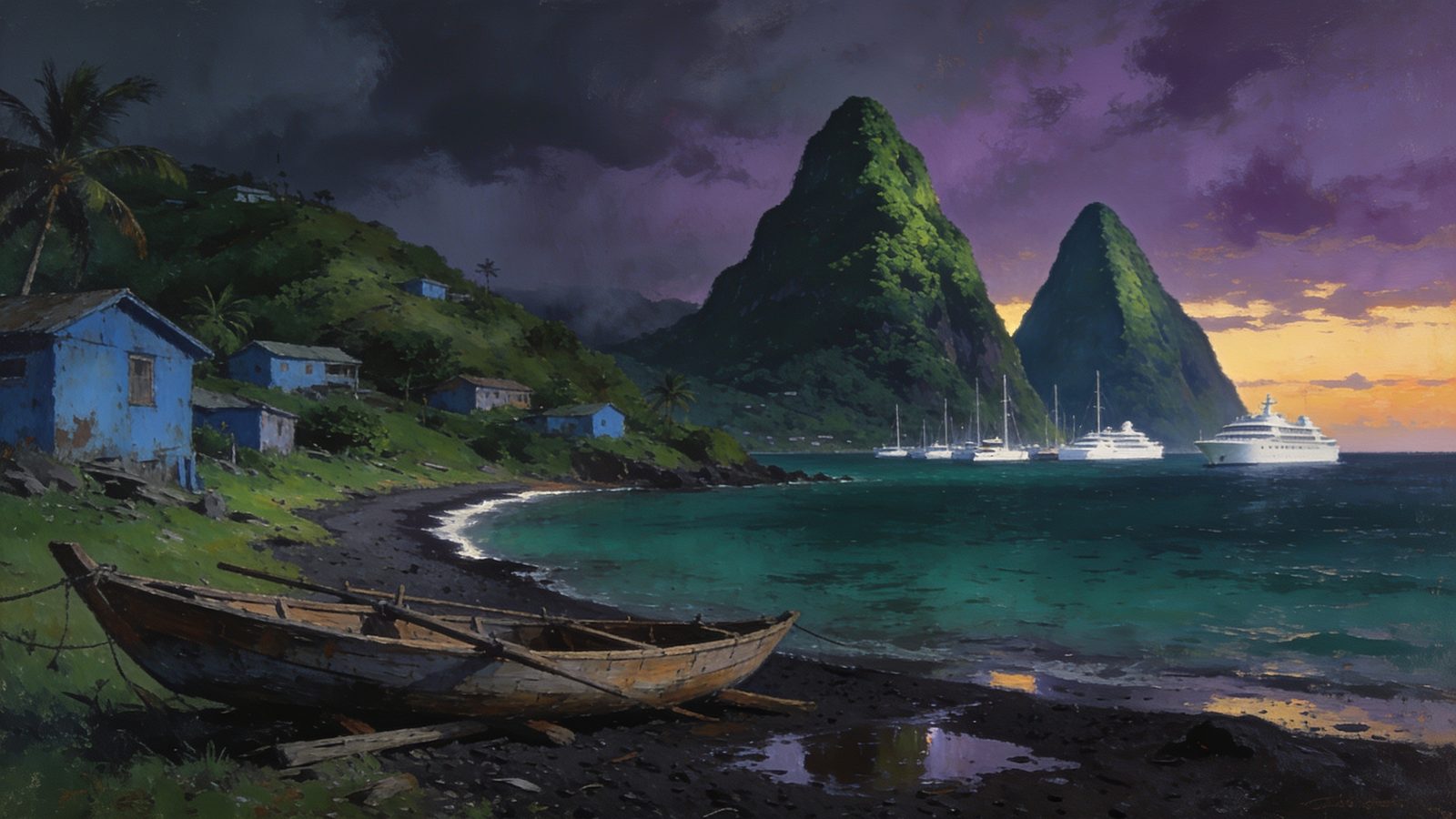
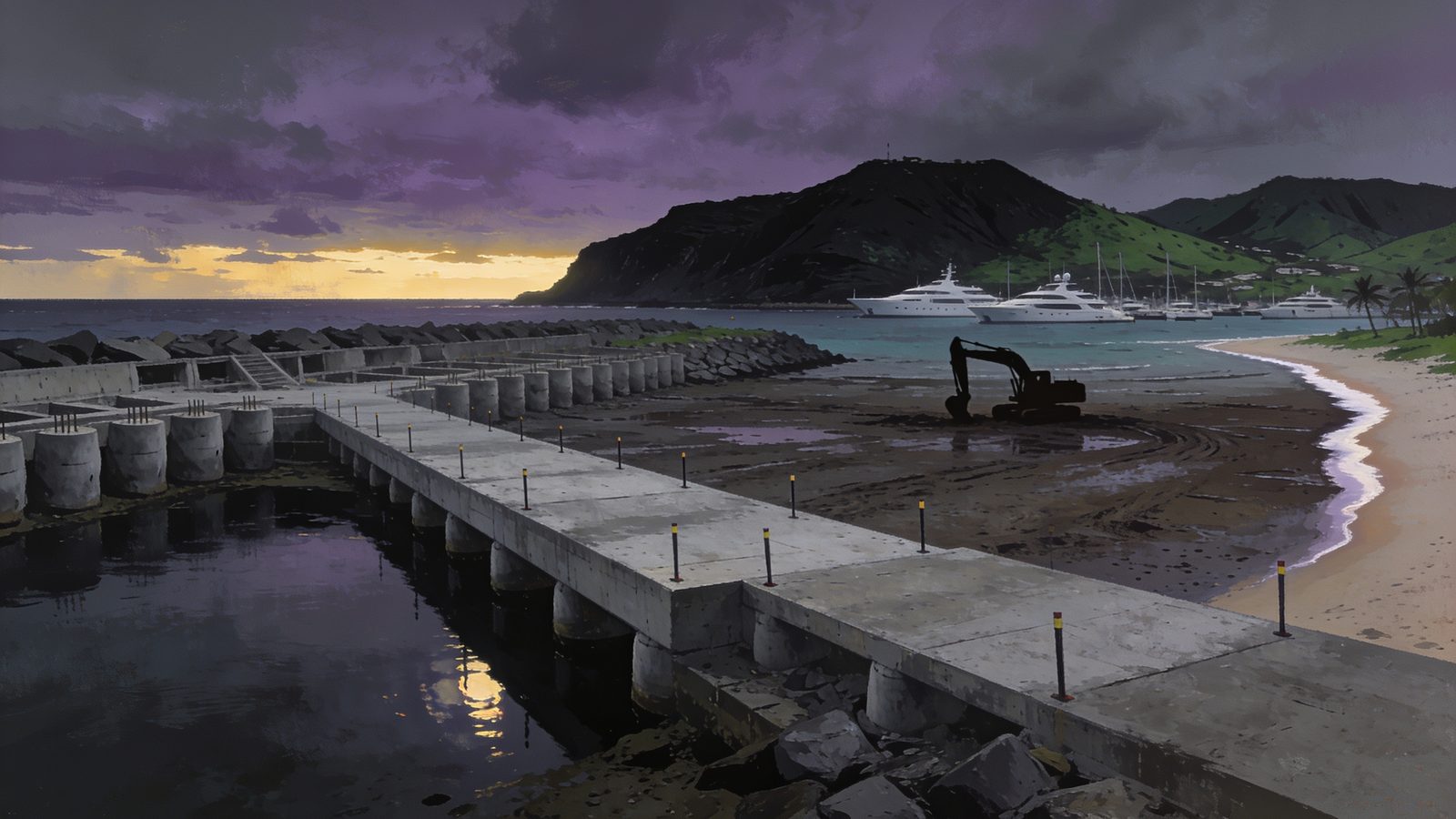
On one side, the fishing co-op. Pirogues hauled up on the sand, a co-op ice machine grinding away before dawn, men who have read that water their whole lives and could tell you the tide without looking up. On the other side, riding out where the bay opens to the sea, the white hulls of an all-inclusive marina. A wall, a gate, a private dock, a development company with very good lawyers and a coastline it would like to own. Green fig and saltfish for the people who live there. A tasting menu for the people who flew in.
Both of those things are true in the same hundred yards of water, and the gap between them is where every story I want to tell lives.
That gap is not invented. The luxury-development money, the resort that eats the public beach a meter at a time, the families who have fished a bay for six generations and now cannot afford the houses above it — that is the real pressure running underneath the postcard. I did not have to manufacture menace. I had to look at who the postcard was actually for, and who was quietly paying for the privilege of being in the background of it.
The sea in those stories does two jobs. It is the most beautiful thing in the frame, and it is the thing that keeps the secrets. It takes people and, eventually, on its own schedule, it gives some of them back.
The light, and why noir needs it
Let me tell you the thing the brochures never prepare you for. Caribbean light is not soft.
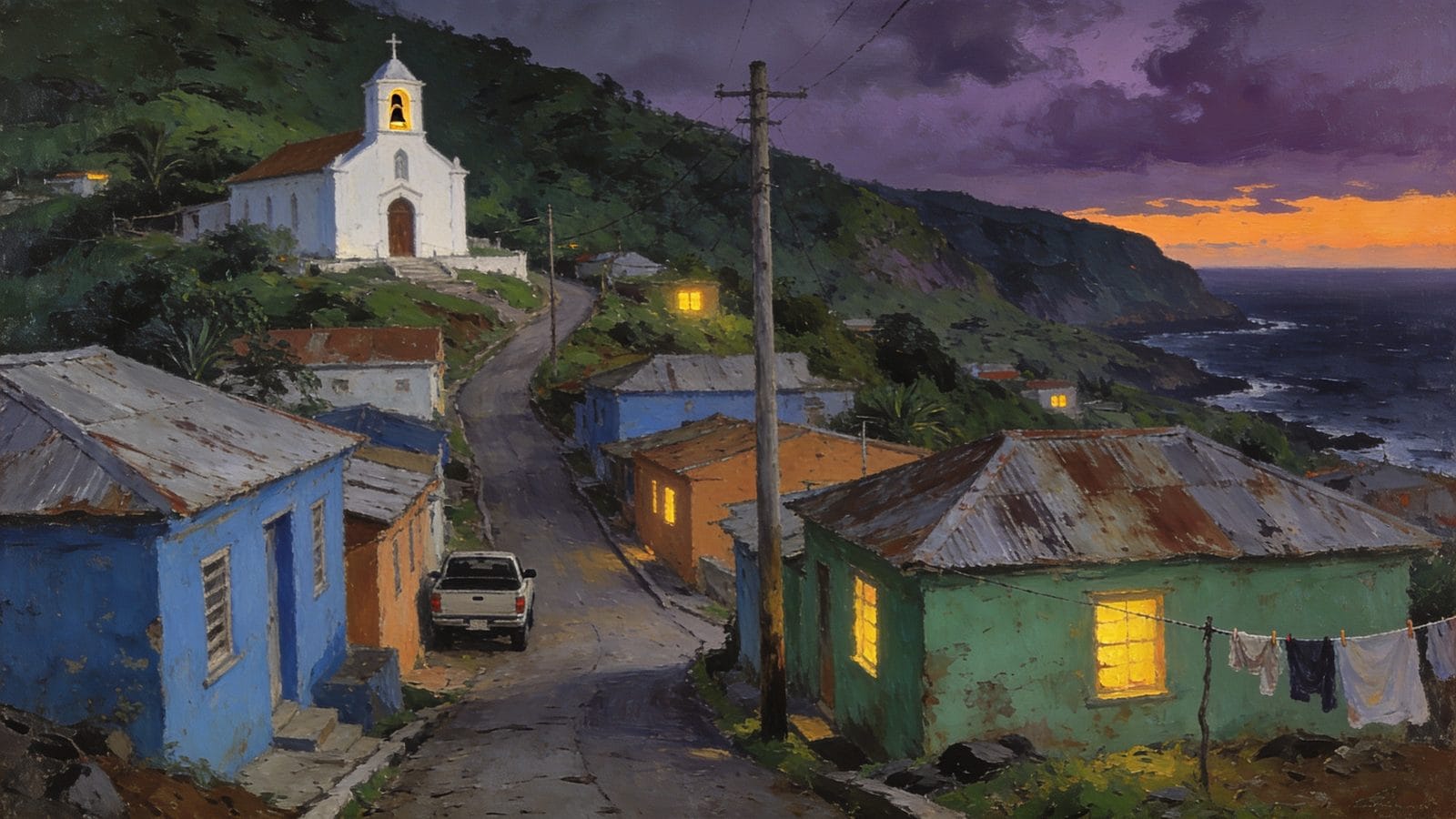
We think tropical, we think gauzy and golden and forgiving, a filter over everything. It is not. Midday light near the equator is hard and flat and merciless. It bleaches a wall to bone. It shows you every crack in the paint, every salt stain creeping up a blue house until the blue is mostly a memory of blue. There is nowhere to hide at noon.
And then it drops. Fast.
You do not get the long, slow, romantic dusk of an English summer evening, that hour and a half of going gold. Near the equator the sun goes down like a coin into a slot. One minute the sea is a hard bright teal you could read a newspaper by, and twenty minutes later it is black, and the line where the water meets the dark is just gone. The whole bay changes character in the time it takes to walk home.
That is a gift to a crime writer. The honest light of the day, where everyone can see everyone and the town watches the water, and then the quick, total dark, when the trucks come that do not come on a fishing day. I did not have to reach for atmosphere. The island hands it to you twice a day, on a hard schedule, for free.
A town that doesn't exist
Here is one decision I made early and have never regretted: the island is real, the town is not.
Saint Lucia is real. The Pitons are real, those two green volcanic spires going straight up out of the sea at Soufrière. Castries is real. The sulphur springs, the Friday night jump-up at Gros Islet, Jounen Kwéyòl in October with the madras cloth and the cocoa tea, the bélè drum, the La Rose and La Marguerite flower societies. All of that is true, and I worked hard to get it right.
But the town my journalist comes home to is invented. I call it Bellefond. The name is a small, mean joke I let myself have. It means, roughly, beautiful depth. A lovely surface over dark water. The resort is invented. The development company is invented. The charming local man with the very good reputation is invented.
This is standard thriller practice, and it is not cowardice, it is respect. I am not going to plant a murder and a money-laundering scheme on a real fishing village with real families and real names. That would be a slander dressed up as a setting. A fictional town on a real island lets me keep everything authentic — the food, the language, the light, the history, the actual texture of the place — while inventing the people who do the terrible things. The island gets to be true. The crimes are mine.
The language under the language
This was the hardest thing to get right, and the thing I most needed a real place for.
My narrator speaks clean, educated, lightly accented English. That is deliberate. She is a woman who left at eighteen and built a career in cold English newsrooms, and that control is her professional armor. She manages everyone. She does not perform her island for anyone.
Until she does. Grief pulls it up through her. So does fear, and bone-tiredness, and standing in front of an old woman who has known her since she was small and will not be managed. The Kwéyòl comes up before she chooses it, and she catches it a half-second after, never before. A phrase like Sé lanmè ki pwan'y — the sea took him — that an old woman says behind her on the beach, and she answers in the same register before the reporter in her can stop it. Sa ou kay fè, Séraphine? an aunt asks her, flat, not unkind. What are you going to do. It is not the official's question. It is the older one the parish has always carried to her door.
That involuntary slip is the whole character in one move. The returnee who is never fully home and never fully gone, an insider and an outsider in the same body, and her own mouth keeps proving it. You cannot fake that with a place you invented out of nothing. You need a real language with real rules — when it surfaces, who it surfaces with, what it costs — and Kwéyòl gave me all of it.
I made myself two rules and have kept them. No eye-dialect, ever. I will not spell a person's accent out phonetically and turn a living language into a costume. And no footnotes. If you do not speak Kwéyòl, you will still feel exactly what that line means from the woman who says it and the silence after. Meaning by context, the way it actually works at a kitchen table.
What I got wrong, and what I'm still nervous about
I'll be honest with you, because pretending otherwise would be worse. I am an outsider writing this place. I do not get to be casual about that.
So I read. A lot. I read about the citizenship-by-investment programs that several Caribbean states genuinely run, where you can buy a passport through a real-estate investment, because that is a real seam where clean tourism money and very dirty money run through the same beautiful coastline. I read linguists on when and why Caribbean speakers code-switch — turns out it tracks closely to intimacy, frustration, and pride, which is exactly the engine I was already building under my narrator. I learned that obeah, the spiritual practice, is lived community texture and not a horror prop, and that conflating it with Haitian Vodou is both wrong and lazy, so I do neither.
I got things wrong in early drafts. I had the dusk lasting too long, like an English one, until I caught it. I leaned too hard on the Pitons, because they are the easy postcard, until I made myself find the un-pretty details instead — the flaked lettering on a fishing boat, a single canvas shoe set down neat on a thwart with the laces still tied. The brochure gives you the volcano. The story is in the shoe.
Am I still nervous? Yes. Of course I am. A place is not a research project, it is somebody's home. I have sensitivity readers on the cultural material, and I will keep them. I would rather be told I got it wrong before publication than be told gently, by a reader from there, after. That is the deal I have made with this series, and I intend to keep it.
So, why Saint Lucia
Because it would not be a postcard. Because it is a place that has spent three hundred years being two things at once — French and English, paradise and pressure, the most beautiful thing in the frame and the thing that keeps the secrets. Because the light tells the truth all day and then drops like a stone. Because a woman can come home to a bay she loves and see, more clearly than anyone, exactly what it does to people.
I went looking for a backdrop and I found an argument. That, in the end, is the whole reason. You cannot write a good crime novel against a backdrop. You can only write one inside a place that is already arguing with itself.
That is my take, anyway. The island made me a better liar by being so stubbornly true.